

He isn’t much in the eyes of the world
He’ll never make history
No, he isn’t much in the eyes of the world
But he is the world to me
My dad, now here is a man
To me he is everything strong
No, he can’t do wrong, my dad
My dad, now he understands
When I bring him troubles to share
Oh, he’s always there, my dad
When I was small, I felt ten feet tall
When I walked by his side
And every one would say, “That’s his son”
And my heart would burst with pride
My dad, oh, I love him so
And I only hope that someday
My own son will say
“My dad, now here is a man”
—Barry Mann and Cynthia Weil, “My Dad”
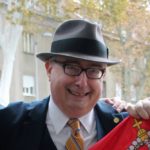
This past July 1, while the greater world was busy praising or condemning the SSPX consecrations and readying for the upcoming 250th anniversary of the Declaration of Independence, I was a bit distracted from contemplation of these milestones. In addition to those important moments, that date was the feast of the Precious Blood of Jesus (which is also the theme for the entire month); the feast of St. Junipero Serra, founder of California; and Dominion Day, commemorating the date in 1867 on which the British North America Act took effect and the Dominion of Canada came into being. But important as all of those dates are, it was also the 30th anniversary of the death of my father, Guy Joseph Conrad Coulombe.
Now, personal as that tragedy was, it does have a larger significance. Let me explain. My father was born in 1926. His parents named him after Guy de Fontgalland, then the youngest non-martyr ever proposed for sainthood (it says something about my grandparents that they also named my Aunt “Fleurette” after the recently canonized St. Thérèse of Lisieux). His hometown, New Bedford, Massachusetts, was one of the centers of the French-Canadian diaspora of New England—a community then torn by the near schism of La Sentinelle and assuaged by the prayers of the stigmatist of Woonsocket, Little Rose Ferron.
Educated in both French and English, he was perfectly bilingual. For all that my father and his family were proudly Francophone, all of his uncles served in World War I in the American forces. Staunchly America First and believing FDR pushed the Japanese into war, he still volunteered on his 18th birthday in 1944 although, as a widow’s only son, he was not required to go.
Based in Tinian in the Marianas, Dad was a tail gunner. Their average lifespan in combat was a matter of seconds; Dad made 13 successful missions. He used to say, “other men believe in God; I know!” Out of thanksgiving, he joined the Graves Detail in the immediate aftermath of the war—first finding bodies of his brother servicemen in places like Iwo Jima and then accompanying others home by train. Demobilized, he attended the American Academy of Dramatic Arts in New York City and returned to the omnivorous reading he had left behind in 1944. He went into radio acting and met my mother on a radio sound stage in 1951.
They lived and worked in a confluence of theatrical, literary, musical, and other artistic personalities unequalled in 20th-century America. They did their best to pass on to their two sons the combination of absolute faith in the Catholic Church and an incredibly wide range of knowledge and experience they shared between them. Theirs was not a soft religion of naivete but a hard-as-nails view of reality. It accepted the paradoxes of life as the price of breathing—and we would need this to get through the storms of the 1960s as a family.
Theirs was not a soft religion of naivete but a hard-as-nails view of reality. It accepted the paradoxes of life as the price of breathing—and we would need this to get through the storms of the 1960s as a family.Tweet ThisBut all the while, my dad was doing his best to shape us—not into a particular mold, but rather, by helping us realize exactly who we were, to discern the very different gifts God had given my brother and me in order to develop them—and to explore our weaknesses, to either repair or live with them. In a word, he felt it was his God-given calling to help us achieve whatever it was God had made us to be. This was his goal through financial ups and downs, through Catholic and public schools, through the Boy Scouts (we are both Eagles), and then into our respective professions.
When Paul Petersen plaintively sang the above song on The Donna Reed Show back in 1962, he captured a certain feeling about one’s father. But when Dad died in 1996, it was another tune that reduced me to tears in a McDonald’s near my home—Dan Fogelberg’s “Leader of the Band”: “He earned his love through discipline, a thundering velvet hand; His gentle means of sculpting souls took me years to understand.” All of this being true, one can perhaps understand why this 30th anniversary of his death was so especially poignant. As every year, this poignance, this overwhelming memory of fatherhood and its departure, lends a particular shade for me to the feasts and observances that share the date.
The first is, of course, the feast of the Precious Blood of Jesus. Now, the occasion of the feast being placed on the Universal Calendar was Pope Pius IX’s return to Rome after the revolutions of 1848. This elevation of a feast dedicated to the Salvific Blood of Our Lord was the appropriate response of a father who had been unable to save his sons from murdering each other—that Blood whose presence made the Grail Holy, as It does every chalice into which It has transubstantiated since that first Maundy Thursday. Eucharistic miracles, bleeding images, holy relics of all or some of these things—the tangible proofs of the Real Presence in the workaday world—cannot be gainsaid. Although it was the Blood of the Son that was shed, His Father’s paternal, self-sacrificial love was also present.
As with any decent father, my dad loved his wife and sons more than his own life. He was, in a sense, our domestic priest—directing our devotional life as a clan. Every father must make some sacrifices for his family—even if that is only of a few trifling habits. Above all, he must give up some of what the world calls freedom in return for his children.
Every father must make some sacrifices for his family—even if that is only of a few trifling habits. Above all, he must give up some of what the world calls freedom in return for his children.<br>Tweet ThisThe second great observance of July is the feast of St. Junipero Serra. If ever there was an image of loving fatherhood, it was this Apostle of California. His care for the Missions—begun as a student and professor of Llullist philosophy in Majorca—impelled him toward the missions of Mexico’s Sierra Gorda, then Baja California, and, at last, as a pioneer evangelizer of Alta California. His paternal administration of the Mission Indians and his love of their souls radiated St. Junipero’s true, self-sacrificial fatherhood. The way he offered up to God his many sufferings for their welfare again cannot but remind us of a decent father.
When we moved to California, my father shifted our familial explorations of colonial byways and relics—such as we had done in New York and New England—to Spanish California and the Missions. We loved Zorro and Ramona, and we meticulously explored the Spanish sites within easy reach: Missions San Fernando and San Gabriel, and Olvera Street and the Plaza church. Ancient adobes connected to Spanish land grants were another favorite. Dad brought to life for us the adventures of the padres and rancheros in this new land of ours. Eventually, I visited all 21 missions, and I have never lost the love of Spanish California my father gave me.
The other great occasion on this day is Dominion Day, honoring the coming into effect of the British North America Act in 1867. The authors of the bill, the “Fathers of Confederation,” were a remarkable group of 36 men who represented British North American colonies at the Charlottetown (1864), Quebec (1864), and London (1866) conferences. Representing the then-colonies of Lower Canada (Quebec), Upper Canada (Ontario), New Brunswick, and Nova Scotia, these men were consumed with several loves: for their queen, for the British Empire of which they were part, for their respective colonies and peoples, and for the future country they might create between them.
They wanted to name the entity the “Kingdom of Canada,” but the British authorities demurred, warning that this would annoy the newly reunited United States of America. But these Father laid firm foundations—not only for Canada but for the Commonwealth of Australia, the Union of South Africa, the Dominion of New Zealand, and, ultimately, the Irish Free State, all of whose foundings and original format were inspired by 1867.
My father always pointed out that while we were Americans and our first political loyalties must always rest with the United States (as mentioned above, he was a tail gunner against the Japanese in WWII; all of his uncles served in WWI; and my brother and I have both served—he for a long time and bravely, me for a short and comfortable time), we must never forget whence we came. Our first ancestors in Canada came from France in the 17th century. We fought the invading British in four wars and then the invading Americans in two more—after which we eventually came south in the 1880s.
The loyalty our fathers gave the French and then the British Crown we gave to the American flag. But it is a familial loyalty, forged in combat by generations of men who left their families and hearths to risk—and often lose—their lives in the service of King and Country. This loyalty, too, is another facet of the paternal love my father passed on to us.
It is a familial loyalty, forged in combat by generations of men who left their families and hearths to risk—and often lose—their lives in the service of King and Country. Tweet ThisIn this light, the ecclesiastical events of July 1, 2026, are just another example of the massive failure of fatherhood which is the hallmark of our time. I do not care to argue over the rightness or wrongness of the SSPX or their excommunicators. The entire situation is the result of a process throughout society across the globe, of which the current situation in the Church is merely a symptom—albeit one by which souls may be lost.
Was it paternal love that inspired the liturgical changes in the first place? A deep desire for the salvation of the souls of the faithful—of the application of the merits of the Blood of Christ to every fallen being on earth? Was Cardinal Villot’s ultra vires 1976 forbidding of the Signatura to hear Archbishop Lefebvre’s case motivated by such a love? Was attempting to shut down every church on the planet such love—or the issuing of Traditionis Custodes afterward? For that matter, one may ask if some of the SSPX leadership are consumed with a love of souls when they advise those not near to Latin Masses to avoid Mass and Communion entirely?
But the loss of fatherhood is not restricted to the clerical class. It is among us all. Why have the 250th celebrations been muted? There are several reasons, of course. But one is that a sense of patriotism—a love of the patria, the Fatherland—is, like it or not, bound up with the love received from and returned to one’s own father. There is a reason that the downgrading of patriotism throughout the West became de riguere in the 1960s—at the same time fatherhood began receding via divorce, etc.
With the concept of actual fatherhood fast vanishing from real life, those two public roles that most partake of it—ruler and priest—tended to lose their qualities as well. Politicos and clerics thought ever less of the real needs and welfare of their subjects and communicants. The idea that these bodies and souls were committed to their care as they are to their fathers became entirely lost. This, in turn, had its debilitating effect on actual fathers, in the priests and officials they encountered.
What can be done? It is up to every man, and certainly every Catholic man who decides to get married, to commit himself entirely to the notion of fatherhood. That includes not only the obvious roles of love and guidance but of being both priest and king at home. Regardless of the theological or political issues they shall face in their time, a generation raised by decent fathers shall be well-equipped to confront the challenges that face them; those called up to exercise leadership in Church and State will find they have already learned key elements of their position before ever going to seminary or public service.
There are no comments yet.