

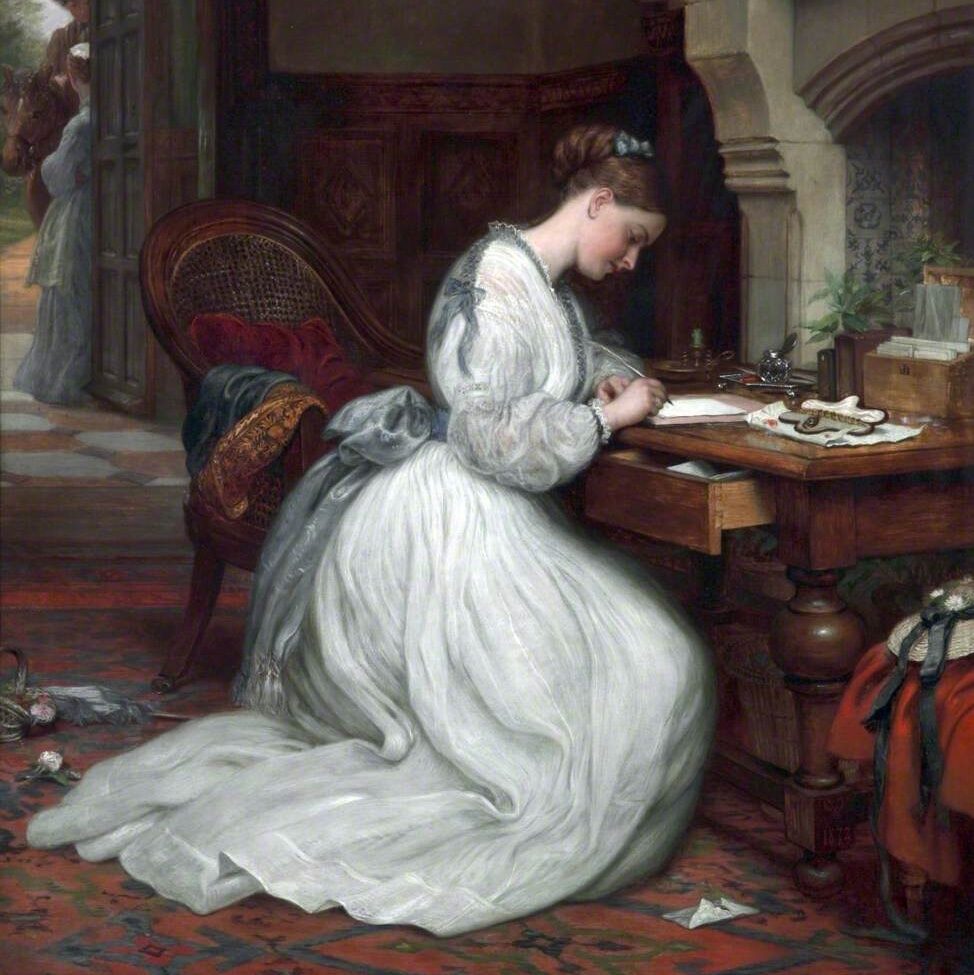
I made my decision during my first year of high school. What has followed has been a consistent string of reactions.
“You’re not going to college? But I thought you were going to do something big!”
“Come on, you have to go to college! With the world as it is right now, it’s impossible to live life without a degree!”
Sometimes the response is not made through so many words, but the meaning is the same. A frown. A shocked look. A mere, startled question, “You’re not going to college?!” Or a raised eyebrow.
I realize that, oftentimes, many of these reactions to my decision not to pursue a college education are unintentional; and some are even kindly-meant, such as the urgings of those who believe the only way to survive life in the 21st century is through possessing a degree. However, in the seven years since I made the decision to forego a college education, I have consistently received any number of the reactions listed above, or something similar.
I had big plans for my life at one point. From around the age of seven, I already had my career path planned: I was going to be a doctor. I thought of myself as nothing but a future member of the medical field. I had a doctor’s kit I played with regularly. I had a doctor’s “clinic” set up. I pretended I was a student in medical school. I regularly asked my mother to keep “Human Body” workbooks in my pile of homework so I could start preparing now for what would come later. I even enjoyed being in the hospital after an operation for acute appendicitis because it gave me a chance to “visit” my future workplace.
So, you might be asking, what changed? What turned The Success into A Failure?
Things just didn’t square, for one thing. Like for so many other girls, in my early teenage years marriage suddenly became an attractive thing. My mother was never one to pretend, and she always made it clear to me from the beginning that, if you’re a Catholic, with marriage comes children. Add to that my reading of the Baltimore Catechism’s ruthless explanation of what the ends of marriage are and I realized there was more to it than the fairy-tale romance portrayed by society—at least at the time; society’s romanticization of marriage has fallen at a surprising rate in only a decade.
In addition, I always had a hard time agreeing with the feminist view of female empowerment. I believe this is due to the fact that I grew up in a household where I regularly witnessed my mother’s example of how, in the hierarchy of marriage, the man holds the authority in the household and his wife ought to be submissive to him. As an 𝕏 user commented recently in a post that strongly resonated with me: “We often forget little girls are still on factory setting [sic]. The feminist propaganda hasn’t sucked their souls out.”
It was during the first semester of my freshman year that I started to realize that the life I had so carefully planned out throughout my childhood, and for which I had waited for so long, was likely never going to come to fruition. The program I was homeschooled with required students to take an Education and Career Planning course. And as I wrote out my yearly plan for the future and saw eight years of my life go into med school for a career that I would likely not be able to balance when I got married—if I was sure of one thing, it was that I had a strong desire for marriage—I realized I was in for a miserable life. It was not what I wanted.
I was wary about admitting any changes for the future, but the writing was on the wall. When Covid hit and I delved deeper into studying the Catholic Faith—and learned about the detrimental effects of feminism on society—I faced the writing and made my decision. In short, as I tell people who ask why I didn’t pursue college, the costs outweighed the benefits.
In short, as I tell people who ask why I didn’t pursue college, the costs outweighed the benefits. Tweet ThisIn the seven years that have passed since I was a freshman, I have had to come to terms with people viewing me as a waste, a subpar citizen—perhaps even a detriment to society. I could have been “more.” I could have been “something big.” As it turns out, I was only worth something so long as I was getting an education. Now, because I am not following a path that will bring a degree to my name, I am worth nothing.
Not all people I meet are this way—and to those who do not make me feel inferior based off of my educational pursuits I am grateful—but those who are have learned to make me flinch whenever the question of college comes up. The same goes for other young people I know who have chosen not to pursue college. This is a burden we will be compelled to bear by society, perhaps for the rest of our lives.
Uncomfortable though they may be, I do not automatically attribute these conversations to ill-will from the people who initiate them. During the past few years, there is something that has become increasingly apparent to me: society underwent a collective brainwashing when it comes to education. Education is the modern world’s sacred cow. This is evident in how people react when someone decides to go against the grain and forego a college education. It is the ultimate tragedy. Again, I do not blame the people themselves. Like feminism, idolatry of education has slowly seeped into people’s minds through cultural messaging, to the point where it appears unimaginable for someone to choose a different way of life.
Like feminism, idolatry of education has slowly seeped into people’s minds through cultural messaging, to the point where it appears unimaginable for someone to choose a different way of life.Tweet ThisIt is so unimaginable, in fact, that it is acceptable to tell a young person fresh out of high school, “I thought you were going to be something big,” without it being considered the least bit hurtful.
This viewpoint is the most repulsive when it comes in response to a young woman saying that she chose to bypass college to focus on being a wife and mother. To practically call someone “useless” for choosing to devote herself to one of the most noble duties—a duty so noble that even our Blessed Mother undertook it—-should be unimaginable. Firstly, it is an unnecessary application of pressure in the already-confusing society young women are living in. Secondly, it is downright cruel.
I chose to title this piece “The Inferiority Complex of the Hick High School Graduate” because the types of reactions from people I have detailed above do, indeed, make us feel inferior, even if we are firm enough in our decisions not to be budged by the opinions of the general public. I do not say this to bash those who change their minds about going to college as a result of the opinions they receive from family members and friends; knowing how strong the sway is, I sympathize with them. I myself have reconsidered whether I made the right decision in deciding not to enter college many times in the past seven years based on the opinions I have received from people.
It is wrong, however, to measure people’s worth based on their education. Yet this is the way of the modern, tolerant world—a world so tolerant that it will consider every path wrong save the one it approves of. We should change that.
Very good article. One of the many terrible things about modern feminism is that it, more so than anything else, teaches women that their worth is based solely on whether or not they went to college. It is much easier for men to reject college.
Looking only at the economic aspects, in my case my father worked for a college for most of his career, taking less salary then he could have made in the private sector but with the benefit that I could go there almost for free, so I felt obligated to go. But, while I may have an undergraduate degree and work in software development, I have a younger cousin who fluked out of college in one term and is now a master mechanic who definitely makes more than double what I make (he lives in a part of the country where the cost of living is higher, but even if he lived here he would be making a lot more than me). Then I have a sister who has a masters degree but is working at a major retail store (the night shift). Despite having that degree she made lots of really bad decisions with her life. She used the degree for a few years, in a lower-salary position, but now is unlikely to use it anymore and her and her two daughters live with my mom, making my mom’s life miserable (all three have mental and spiritual issues). The great irony is that she probably would have been better off if she had gotten pregnant in high school! In that case she would not have wasted over 10 years of her life in college getting a degree that she is probably never going to use, and could have studied for a more practical non-college field when the child was older, and would more likely be independent now, and probably much happier.
And with the advent of AI, as the previous commentator mentioned, the long term prospects of many careers that require college degrees looks much dimmer. AI can already write software in a couple minutes that would take me a week to write (I know, because I had it do just that). I sometimes think that I may need to get training in a trade field, and change careers.
The law of supply and demand is what drives salaries, but this is something that those who go to college rarely actually learn until (maybe) afterward. If there is a field that requires some specialized training (not necessarily college) with few people in it but much demand for its services, it can command large salaries. But with a field with many people in it, even if it requires a college degree, and little demand for its services, the employer can in theory get away with paying minimum wage. I remember a high school teacher’s position that opened up here about 15 years ago, that got over 1000 applicants. If it was not unionized the school could have easily paid the lucky person who got it minimum wage (and they would take it). I guess everyone wants their summers off 🙂 .
But looking beyond the economic aspects, and while our careers may be more important than our educations, our Catholic faith and our families is ultimately infinitely more important. In the end that is what God is going to judge us on, and even in this life it is what will make us most happy.
Good article and I agree with much of what you shared Andrea. Society is in for a rude awakening in the coming decades due to AI. Even medicine will change as a result of what it is capable of. That being said, here is some logic that supports decisions such as the one you made:
1). Which is more ‘useless’ – the person who has goals they pursue that don’t involve college or the person who wracked up debt for a degree in gender studies etc? There are some pursuits that require college but not all and getting next to worthless degrees at great debt is not ‘useful’ to anyone.
2). The beauty of education is it is always there. You can go at any point in your life if you choose to. My mother chose motherhood until her last child was as of driving age then went to college to be a teacher, she now has a masters.
3). Motherhood is extremely important, as is fatherhood but with latter ‘providing’ was naturally built in and so can be easier to accommodate. Men can have kids when they are 70, not typical for women.
In the end, my friends in the trades are doing better now than many of my friends with degrees. The only cases where that is reversed is when their degrees were specifically targeting a field that needed one – engineering, education, medicine etc.