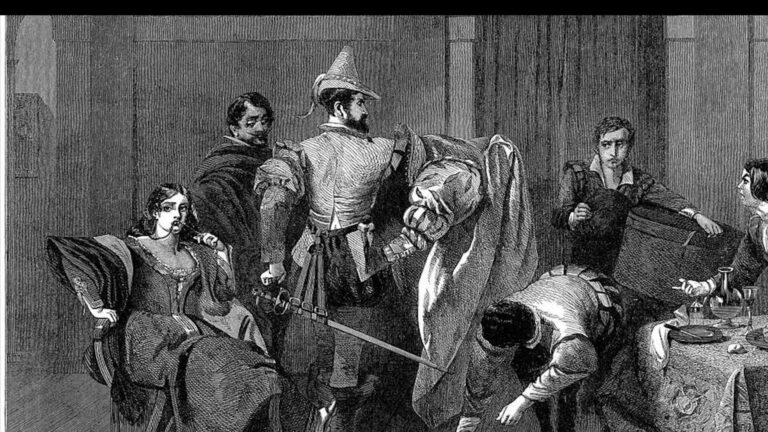
We Are All Shrews to Be Tamed
Shakespeare’s Taming of the Shrew, beyond the comedy, is a spiritual allegory mapping the rebellious soul’s journey from disordered passions to union with God.


Shakespeare’s Taming of the Shrew, beyond the comedy, is a spiritual allegory mapping the rebellious soul’s journey from disordered passions to union with God.
A recent film, All Is True, released this past May and starring Kenneth Branagh as Shakespeare and Ian McKellen as Shakespeare’s patron, the Earl of Southampton, purports to be a depiction of the Bard’s final years in Stratford-upon-Avon following his retirement from the London stage. Making no effort to remain true to the known facts … Read more
Professor Mark Bauerlein has recently argued in Public Discourse that liberalism, or the moral and epistemological relativism it engenders, starves literature of the narratives that alone can provide a work with meaning. Indeed it suggests that meaning itself is an illusion; and, once that is said, art disappears, and only the wraith of escapism, or … Read more
I’m currently in the midst of watching Sir Kenneth Clark’s celebrated Civilisation, first broadcast by the BBC in 1969 and subsequently by PBS. I had heard so much about it, and remember watching it as a child, and was looking forward to having a guided tour of Western Civilisation by one of its most outspoken … Read more
Well did John Senior advise parents and teachers to prepare today’s youngsters for great study, with experiences of the good, such as gardening, graceful dancing, and gazing at the stars dancing above, and also making sure to delight in a thousand good books, before getting to the hundred or so great books by the master … Read more
Almost five hundred years after his death, William Shakespeare remains one of the most important figures in human history. Standing shoulder to shoulder with Homer and Dante, he is part of the triumvirate of literary giants who straddle the centuries as permanent witnesses of the permanent things. It is, therefore, gratifying that modern scholarship is … Read more
It is about this time in Lent, around halfway through, that one begins to wonder what the point is. Of anything, really. One purpose of the season is just that: to bring us up against impossibilities. Today, I’m thinking particularly of impossibilities in the realm I am compelled to stare into in my daily life … Read more
Good morning! In honor of the silliness that will be descending upon us this weekend with the arrival of Halloween, today’s wrap-up is completely devoid of any valuable news content. Consider it candy for your brain. Virtually no child has ever been harmed by the ol’ “poisoned Halloween candy” trick. So why are we still … Read more
All the decorations are up, folks are frantically shopping and preparing, and the anticipation is almost killing me as I await the brightest, best moment of the whole liturgical year: Halloween, of course. As far back as I can remember, this feast far outclassed Christmas on my personal calendar. No matter that Santa brought piles … Read more
Thanks to Mark Shea (you did read his column this morning, “Counsel the Doubtful,” didn’t you?) for sharing this hilarious read: What happens when an American anthropologist tells the story of Hamlet to some African tribesman? Laura Bohannan’s thesis that “human nature is pretty much the same the whole world over” met its match in … Read more
Yesterday marked the 100’s anniversary of the birth of the man considered by many to be the greatest, most influential film director of all time: Akira Kurosawa. Affectionately (or fearfully, perhaps) known as “The Emperor” on his sets, his visual style, thematic ideas, and absolute mastery of the medium profoundly influenced countless generations of filmmakers. Spielberg once referred to … Read more
Lewis Theobald was dismissed as a hack in the 18th century when he published Double Falsehood and claimed that it was an adaptation of a lost Shakespeare original. Now, some Shakespeare scholars believe that he was telling the truth all along: ”There is definitely Shakespearean DNA,” said English literature professor Brean Hammond, who has worked … Read more
A few days before the New Year Chippy and I spent the day studying Shakespeare. In the morning we looked through “Shakespeare’s Complete Works” from my college days at the University of Texas, complete with my teenage marginalia. Then, I asked Chippy to read from the balcony scene in “Romeo and Juliet,” and later that … Read more
A few days before the New Year Chippy and I spent the day studying Shakespeare. In the morning we looked through “Shakespeare’s Complete Works” from my college days at the University of Texas, complete with my teenage marginalia. Then, I asked Chippy to read from the balcony scene in “Romeo and Juliet,” and later that … Read more
The argument that Shakespeare may have been a Catholic is not new, but a seminary in Rome is claiming to have evidence that is. The Venerable English College says that a guest book for visiting pilgrims contains three signatures that could indicate that the Bard traveled there during his “lost years”: Father Andrew Headon, the … Read more
Some years ago, my kids got a computer game called Myst. It‘s a very curious game — there are no instructions, no rules, and no commentary offered at the beginning. You find yourself plunked down into a strange environment on a mysterious island. You don‘t know where you are or why you‘re there. As you … Read more
A great and growing difficulty for the Catholic Church, and all her faithful, is the disintegration of modern languages. Words used through centuries to connote deep meanings — not incomprehensible, but superficially complex — come to mean less and less. The glib use of a word such as “prophecy,” to mean only a prediction of … Read more
When Joseph Pearce’s epically titled The Quest for Shakespeare was released from Ignatius Press earlier this year, the Catholic blogosphere erupted with reports that William Shakespeare was finally, 400 years after the fact, proud to be papist. Although early modernists (a.k.a. Renaissance scholars) have been pondering Shakespeare’s possible relationship with the Romish Church for decades … Read more
Beethoven, Shakespeare, and the rest — how we extol them. “Oh, I do love his 7th Symphony so much!” Or, “Oh yes — ‘To be or not to be. . .’ — so powerful. So immeasurably profound.” The thing about all of this, of course, is that once one has graduated from school, the chances … Read more
A very tangled situation arises in one of Shakespeare’s lesser-known plays, Measure for Measure. This is to say nothing particularly arresting; after all, what do we come upon in any of his plays but tangled situations? We all know the agonies and cross-currents in Hamlet and Macbeth, of course. (To my own mind, King Lear … Read more