

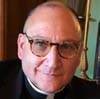
That October 2, 1979. That Cathedral of St. Patrick in New York City.
Pope John Paul II was paying a visit to that storied cathedral. As he solemnly strode the middle aisle, he paused at the altar rail.
Someone was waiting for him—Archbishop Fulton Sheen. The aged and disabled phenomenon attempted to kneel and kiss the pontifical ring.
The pope stopped him, looked into his eyes, and repeated the words of Our Lord to St. Thomas Aquinas 800 years ago: “You have written and spoken of Our Lord Jesus Christ. You are a loyal son of the Church.”
Two months later, Blessed Fulton was found dead in his chapel, praying before the Blessed Sacrament.
To add to the encomia that have already been written about Sheen seems a fool’s errand. But write we must. Somehow praises written over and over again can alone satisfy the depth of gratitude Catholics enjoy for this remarkable priest. Especially this priest.
Standing out among all the facets of his priestly stay on earth was his thoroughly Catholic conviction that the Holy Faith is about God’s truth found only in the Church. She alone saves man from the debacle of his sin-riddled exile in this Valley of Tears. So it is that he preached sermons, broadcast on radio, and spent five years on television. As though preaching God’s truth “from the housetops” was not enough, he penned over 75 books.
Standing out…of Sheen's priestly stay on earth was his thoroughly Catholic conviction that the Holy Faith is about God’s truth found only in the Church. She alone saves man from the debacle of his sin-riddled exile in this Valley of Tears.Tweet ThisWhy such a staggering treasure? Sheen knew his St. Thomas Aquinas well. One of the Angelic Doctor’s principal metaphysical truths was that “knowledge precedes love.” Here, an axiom that falls on the deaf ears of Modernity. Without truth, love is impossible. Love obeys the dictates of truth, otherwise it spins out of control, leaving man in a landfill of tragedy and madness. Modern culture is calamitous proof of this. If right reason’s grasp of truth is not pursued passionately, then man’s passions rule; and they will rule despotically.
Of Sheen’s voluminous reading, the study of Father Garrigou-Lagrange must have been paramount. Here is the great Thomist theologian in The Three Ways of the Spiritual Life:
Indeed, we possess a truth completely only when we teach it to others; when we make others share our contemplation; only then do we truly love a virtue when we wish others to love it also; only then do we wholly love God when we desire to make Him loved by all. Give money away, or spend it, and it is no longer yours. But give God to others, and you possess Him more fully for yourself.
Blessed Sheen recognized that the highest act of sanctity is charity—but charity properly understood as the love of God above all things and the love of others for the sake of God. This formula is foreign to Modern Man, as well as for not a few Modern Catholics. Most believe that charity is the Socialist State, or the trappings of bare philanthropy, or the pursuit of love without justice. To the darkness of that mendacity, the Church’s definition is luminous. Love of God furnishes us with the trajectory of all other loves. Those right-ordered loves then satisfy, they lead, they nurture, they build civilizations.
Blessed Sheen recognized that the highest act of sanctity is charity—but charity properly understood as the love of God above all things and the love of others for the sake of God.Tweet ThisIn this properly understood orchestration of love, Blessed Sheen accomplished his remarkable work. It propelled his untiring labors for the missions.
He did not see mere statistical mouths to feed but starved souls to nourish. He did not align with the narrow understanding of the poor popularized by modernity in their rice bowl campaigns and self-satisfying soup kitchens. He knew well love’s depths. He also recognized that the real “poorest of the poor” were empty souls—not empty bellies. Thus, his ceaseless efforts at conversion.
Nothing brought him more pleasure than bringing souls to the refreshing waters of the Catholic Church. During his priesthood, he brought tens of thousands of souls to the Catholic Church, many quite famous and internationally known.
All of this formidable outreach was marked by the sweet inflections of charity. He spared no anger at the monstrous ideologies that were strangling men—but never anger to those victims of ideology. To them he showed only his infectious smile, endless patience, and welcoming arms of understanding.
Not a few Catholics have found his life and work outdated. They are embarrassed by his full-throated message extra ecclesiam nulla salus. They prefer to leave behind that infallible teaching woefully lacking in their beloved inclusivity.
They align themselves with a view that all religions are paths to God.
They cringe at Sheen’s undiluted invitation to come and find the only redemptive truth in the Catholic Church.
For these, there is only the hope that Sheen will soon be forgotten beneath the debris of Synodal Listening. For others of like mind, there is a different strategy. They shall begin to stretch Sheen’s message to the preferably attenuated messages they have been stitching together for decades.
Look at what they did to St. Francis of Assisi: refitting him into a hippie cheerleader of all leftist causes. Their strategy: better to keep a saint with hundreds of years of cachet and resize him. That accomplishes more with less work.
Sheen’s most dramatic message is probably his love of Christ Crucified, and Him in the Most Blessed Sacrament. He endured the Cross in a fashion unseen by all, by the acceptance of humiliations. The beatus never spoke a word about these, otherwise they would lose merit before God. But suffer he did.
The Great Dominican Theologian Father Sertillanges once wrote: “The greatest suffering is not to suffer for the Church or in the Church, but by the Church.” Sheen knew that well. He was removed from his sensational success of Life Is Worth Living by his superior in New York. When asked why, he simply replied, “for spiritual reasons.” When transferred to the Diocese of Rochester, a move that would seriously curtail his amazing preaching apostolate, he accepted without dudgeon or complaint.
This was his love of the Cross.
There are those in the past 60 years who have mightily struggled to have a resurrection without the Cross. For these Illuminati, the Resurrection erased the Cross.
The result? No longer reparative suffering; no longer struggle against sin; no longer penance, sacrifice or mortification. With that agenda, they purged the Church of the millennial piety that produced its saints. Understandably, to them Blessed Sheen is a slight embarrassment. No wonder for priests of a certain age he is either reviled or a relic of a well-forgotten past.
But for these plunderers, their dreams are already being dashed. For the beatification ceremony saw 1,000 priests! Most of them so young as to seem like children.
Holy Church is slowly, like her Divine Master, rising from the dead.
To illustrate Blessed Sheen’s love of the Cross, an excerpt from his autobiography might enlighten:
When I was a priest, I thrilled at being called “Father.” I found the title “Monsignor” mellifluous, but was I a victim? I enjoyed the prestige of being a university professor, and of appearing on radio and television not only at home but abroad; I was popular, I was sought after, I was loudly applauded after lectures and banquet talks, I was a friend of both royalty and the masses, my face appeared in millions of homes. I made the right kind of enemies, namely, the Communists. But…but… how close was I to the Cross?
I was the priest: was I the victim?
From the age of 7, I watched Life Is Worth Living.
I was captivated each time the television announcer would say: “And now, His Excellency Fulton Sheen.”
Spellbound, I watched him emerge in the flowing purple episcopal cape and his bejeweled pectoral cross. Ashley McGuire recently put it best, “But Sheen’s cape, lace and impeccable style were Catholic formalism at its best. He signaled pride in his office, and pride in the Faith.”
And though I was only 7 and understanding little, I held tightly upon his every word like a miser his gold.
When I watch him today as an old priest, he still holds me spellbound.
How could he not? With his infectious exposition of the richness of the Church’s Faith in a perfected oratory that would make Cicero envious.
Most of all, I am intoxicated by the prospect he preaches of beginning again, and still again, the journey to Paradise.
What more can a Catholic want?
There are no comments yet.