

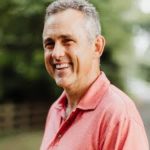
This October, my uncle Msgr. Thomas Wells has been resurfacing like a ghost of warm memory from the past. At a golf tournament held in his honor, through invitations to speak at his former parishes, and in chance encounters with his old friends, I’ve been told stories of how he impacted lives.
After arriving early for an event at one of his former parishes, I sat on a bench beneath an ancient oak tree, just a few feet from where my uncle’s body rests—high on the hill in the old Sacred Heart Cemetery in Bowie, Maryland. The sun was setting behind tall trees, spreading long fingers of light across the ground on the cold night, a beam of which stretched to his grave. Surrounded by trees shedding their leaves and the silence of an encroaching night—I looked at his tombstone, carved with the fitting image of the slaughtered Lamb; he had been murdered in his rectory in June of 2000.
A few memories surfaced: in the days and weeks following my uncle’s death, a few dozen mourners told my family that he was their best friend. We all wondered: How could one man have had so many best friends?
Roads were closed and traffic rerouted for his funeral. Because I had just had knee surgery, someone led me to a seat beneath the canopy spread above the open grave, where I sat next to my uncle’s three sisters and brother, my dad. Standing beneath the June sun behind us was a two-thousand-strong grieving mass, awaiting Cardinal James Hickey, an 80-year-old man who loved my uncle deeply. When he approached, enfeebled and old, I saw in his eyes the same contradiction of grief and confusion of the mourners—the same skipping-record look thousands of others wore after hearing the news of a homeless tree trimmer having brutally stabbed Fr. Wells to death. People from everywhere asked: God, why would you allow this priest to be so gruesomely taken away?
I sat by D.C.’s aging shepherd as he watched one of his most trusted priests, and one the most faithful priests in the history of the Archdiocese of Washington, be lowered into the earth. Six months later, Theodore McCarrick took the cardinal’s place.
It is graves—specifically, unmarked ones—that have gained attention in these parts the past few years, right here on these same grounds. In 2022, hundreds of stones marking the suspected resting places of people enslaved in colonial days were discovered in the woods surrounding the cemetery. The land was once owned by the Society of Jesus, the Jesuits, who operated a plantation here.
A noble and galvanizing parish-wide effort was quickly initiated, where more than one hundred volunteers worked with great heart and diligence to canvas the overgrown and densely-wooded area, working for months to locate every single unmarked grave. A ground-penetrating radar was brought in to survey underground anomalies or the suspected remains of bodies. Laura Masur, Ph.D., an archaeologist and assistant professor at The Catholic University of America, came to offer best practices for identifying and marking graves.
Sacred Heart’s pastor, parishioners, and volunteers saw the effort as a corporal work of mercy, where the dead are properly buried, honored, and their souls are prayed for. Many in the community also hoped their mission would bring long-overdue dignity, atonement, and a measure of comfort to the living descendants of the dead. It was these enslaved laborers who, more than two centuries ago, likely pitched in to snap the string lines, mix the mortar, and lay the bricks that built the rustic and enduring chapel, erected in 1741. John Carroll, America’s first bishop, once prayed here, when anti-Catholic sentiment clung to the newly-formed Republic.
In February 2023, Cardinal Wilton Gregory visited the cemetery to lead a prayer service attended by clergy, parishioners, state delegates, a Jesuit priest, and descendants of slaves, many of whom spoke and wore small black ribbons pinned to their coats that read “forever in our hearts.” Cardinal Gregory reminded attendees that there was still work ahead to acknowledge the history of the Catholic Church’s involvement in slavery.
On November 15th of this year, Cardinal Robert McElroy and an auxiliary bishop, Roy Campbell, will return to the unmarked graves, where they will commemorate Black Catholic History Month through a diocesan memorial service called “On Holy Ground: Pilgrimage of Remembrance.” The four-hour event will include a cemetery walk, praise and worship songs, a “circle of remembrance,” and a concluding Mass.
Since becoming the sixth bishop in San Diego in 2015, Cardinal McElroy has been perhaps the greatest vocal supporter for the policies of Pope Francis, having written, spoken, and homilized on the persecution of immigrants, social inequality, unjust border policies, cultural diversity, bridge-building, synodality, accompaniment, and the Church’s social justice mission.
Bishop Campbell wrote an essay last month titled “DEI Means God.”
Suppose for a moment that you knew nothing of what I’ve just described—that you had never even heard the names McElroy or Campbell. Now, quickly—what does your gut tell you about these bishops returning once more to the place and memory of Jesuit slave ownership, and to the Order’s possible neglect of those enslaved bodies at life’s end?
Or more importantly—and more to the point—what does your sensus fidei say?
If you lack familiarity with the Latin term, The Catechism of the Catholic Church defines the sensus fidei as “the supernatural appreciation of faith (sensus fidei) on the part of the whole people, when, ‘from the bishops to the last of the faithful,’ they manifest a universal consent in faith and morals” (CCC 92). The International Theological Commission (ITC) recently wrote about the history, prominence, and perennial vitality of the sensus fidei—and urged its use by all faithful Catholics, writing:
<em>The </em>sensus fidei fidelis<em> is a sort of spiritual instinct that enables the believer to judge spontaneously whether a particular teaching or practice is or is not in conformity with the Gospel and with apostolic faith</em>.Tweet ThisThe sensus fidei fidelis is a sort of spiritual instinct that enables the believer to judge spontaneously whether a particular teaching or practice is or is not in conformity with the Gospel and with apostolic faith…It is compared to an instinct because it is not primarily the result of rational deliberation, but is rather a form of spontaneous and natural knowledge, a sort of perception…[that comes from] namely the truth of God revealed in Christ Jesus
Since my uncle’s death—two years before the Boston abuse scandals—I’ve come to believe that the Church’s teaching on the faithful use of one’s spiritual instinct and perception is as necessary and vital now as at any point in her history. In an age marked by the loss of the sacred, the rise of the nones, ecclesial infighting, and the diminishment of God in the world and the Church, prayerful Catholics would do well to spend more time listening to the quiet voice of their soul and conscience.
My own sensus fidei has been refined to just a few defining marks: Does this person possess an intimacy with the person of Jesus Christ? And does he or she desire to live for God alone?
Let us return now to that night beside my uncle’s grave. A few hours later, just as I was preparing to leave, I noticed a woman who had waited to speak to me. She approached with a warm smile, telling me she wanted to share a story about how Fr. Wells had helped her in the 1970s. But seven or eight words in, her face crumpled, and she could no longer speak.
Finally: “He spoke to me things no one else could,” she said, tears welling.
“And he began to save me,” tears falling.
She was another who had grown up in Bowie in the wake of the revolutionary changes born at Woodstock, a time when the hippie movement, a heightened sense of autonomy, and a “love without consequences” spirit began pulling teenagers away from the Catholic Faith. Once-stable homes in the parish boundaries of Sacred Heart had become places of rebellion: battlegrounds between parents and teens, where dissension and fear defined families.
It was into this unrest that Fr. Wells became a priest in 1971. Perhaps it was providence, but the start of his ministry came in my hometown of Bowie, where the parish rectory lay in the heart of a neighborhood filled with large Catholic families, many of whom were suffering under the weight of the radically-changed America. I suspect he recognized, as a new priest, that he lacked the wisdom, pastoral experience, and even guts to be a very good father to these suffering families. But I imagine he was even more attuned to his deeper calling of giving parents what they noiselessly begged for: a spiritual father willing to shepherd and even save their frayed families.
My uncle also knew then that the Catholic Church—newly restructured after Vatican II—was mostly ineffective during those years and, in some measure, acted as a Molotov cocktail and accelerant through felt banners, guitar Masses, Communion in the hand, modern vestments, and new slogans like “your work is your prayer.” Because I was barely more than a baby, I don’t remember the transition to the new liturgy, but I imagine the stripping away of the solemnity of the sacred liturgy and softening of perennial Church teaching didn’t help to stop the widening of the gulf in fractured homes.
My uncle also knew then that the Catholic Church—newly restructured after Vatican II—was mostly ineffective during those years and, in some measure, acted as a Molotov cocktail and accelerant…Tweet ThisAttuned to his sensus fidei to father these hurting families, the young priest began to invite himself into homes, where he began to take spiral staircases into souls hardened by anger, revolution, and scabs of cynicism and pride. At dinner tables barely fitting into dining rooms, he sat elbow-to-elbow with large Catholic families and spoke the celebratory language of order and Heaven into tense hearts, explaining the manner in which deeper measures of humility, sacrifice, and patience—practiced by both parents and teenagers alike—would begin to mend the home and, over time, their hearts.
When he sensed he had gained a foothold—when his priestly authority, instruction, and suggestions had been received at those dining room tables—he would shift the mood of the evening and bring tears of laughter, nostalgia, and even shame, depending on how the Spirit moved. As a child, he saw how his father, Stanley, a daily communicant, disciplined his brood and then immediately worked to build them back up. As a new priest, he knew this was the way to go.
When plates were being cleared, he would speak alone to a ponytailed, pot-smoking son or a Joplin-inspired, promiscuous daughter—or anyone he had been told was pulling away from the Faith, the Mass, and even God. In his disarming Irish way, he spoke firmly, but with paternal love, explaining to teenagers and young adults how true freedom, order, and inner peace was only possible by remaining close to God, the Eucharist, and the Faith.
At the end of the night, he met with moms and dads at doorsteps and looked into once-weary eyes that now held peace, gratefulness, and even hope. His parting words often came like this: “Now—begin to suffer patiently and sacrifice for them. They will not return to you, or to reason, until they know you love them in your frustration. And until you begin to trust God that this time will end, peace will come very hard for you. So I beg you—go all in for them.”
As he walked into the night, he would often make a promise that may have sounded like hillside polyphony sung by Bethlehem angels. If you agree to trust in God, then I’ll agree to try to walk with them until they come back.
Until his death at the age of 56, he had maintained multiple close friendships with many of those once-broken families, hippies, and revolutionaries. Almost every single one of them ended up marrying a fellow Catholic and raised their family in the Faith.
My uncle wasn’t a perfect man or a perfect priest, but because he was of one heart and mind with the Church—and because he had a luminous inner life anchored to the Eucharist and devotion to Mary—he knew what had happened to those youngsters in the early 1970s: they had become victims of the contemporary culture. He keenly understood that they needed a spiritual father to try to save them. For 29 years, he listened to what his sensus fidei told him to do as a priest: Lead every soul you can to Heaven.
Outside your front door in October of 2025 is a spreading type of relativism that Cardinal Robert Sarah said is a “bleach [that has] wiped out everything in its path. Doctrinal and moral confusion is reaching its height. Evil is good. Good is evil. Man no longer feels any need to be saved.”
The old notion of agnosticism has given way to something more unsettling: God is no longer considered—let alone debated. For countless millions, religion, faith, and even the idea of God hold no meaning at all. A generation has been swept into this collective amnesia, where the disappearance of God goes unnoticed, where He has become wholly inconsequential.
For millions of former young Catholics—today’s nones—the question of God’s existence has become little more than minutiae, a boring abstraction. Their souls have been seized by the world, by technology, by the glow of their phones. In this new dimension, God holds no weight and is, in a sense, dead—dead in a way even Nietzsche could not have imagined.
I find myself thinking now of the woman formed by the ‘70s free-love culture who approached me the other night, her face collapsing as she spoke of how my uncle had pulled her from a valley of chaos. I think, too, of the dozens upon dozens who, over the past quarter century, have told me how Fr. Wells drew them out of lives of sin. My uncle knew that God is the God of both the living and the dead—but he didn’t waste time in graveyards.
The only time I can remember visiting a graveyard with my uncle was in the west of Ireland, in July of 1992, when my cousin Brendan and I spent two weeks visiting his farming friends in the countryside. One morning, he drove us to County Sligo, to the churchyard at Drumcliffe, where he led us to the grave of the poet W.B. Yeats. Before his death, Yeats had written a poem called “Under Ben Bulben”—the great mountain that loomed just behind us. The final three lines of that poem serve as his epitaph, a sharp piece of undisguised advice for all who pause at his resting place to pay their respects.
Cast a cold eye
On life, on death
Horseman, pass by!
It is easy to see why Thomas Gray’s “Elegy Written in a Country Churchyard” has endured in high school literature classrooms. The heavy truths of the soul and of death come into sharper focus in the breezes of a cemetery in the autumn.
With this in mind, let me return your attention to that scene in the graveyard, where Cardinal McElroy and Bishop Campbell will honor men and women who died more than two centuries ago—stirring up an old wound and casting new light on the Jesuits’ enslavement of Black people.
Now pause, and quickly ask yourself: What does your sensus fidei—your God-given gut instinct—tell you in this moment?
Do the bishops believe that lasting fruit will grow from this act? Or is something else taking root?
In writing this reflection, I found myself wondering how my uncle Fr. Wells might have regarded Cardinal McElroy and Bishop Campbell’s visit to the graveyard. Knowing his no-nonsense, black-and-white way, I suspect he would have seen the gesture as more performative than soul-saving. I could be wrong; but he had witnessed firsthand the conversions, transformations, and renewed order that entered fractured homes in the 1970s—where, as a spiritual father, he spoke hard Catholic truths to young revolutionaries and then softened hearts with joy, humor, and a willingness to walk beside them.
Because his ministry was always centered on the souls of the living, I imagine he would have urged the D.C. bishops—in fact, all bishops—to set aside any gesture today that did not flow from the heart and burden of their identity: the toil of shepherding back into the fold the countless Catholics, young and old alike, slipping away from the Faith.
Again, Fr. Tom Wells was far from perfect, but after traveling the world with him and coming to know the heart of his priesthood over three decades, my sensus fidei rises in me like a fountain now—a geyser of conviction about what he would herald to every bishop in this hour. His message would be plaintive, like the final warning of Scrooge’s last ghost:
Your time is short. Leave your chancery meetings; bring back your millions of “nones” on the road to Hell. The only meeting that matters now is the one that awaits—when the books are opened and nothing remains hidden, when all will be known.
And the question will be answered before it is even asked…
Were you shepherds for my Father alone—or did you shepherd to serve a world that is falling away?
The sensus fidei tells me that McElroy and Campbell are pandering, as is their wont.
Reading this excellent article by Keven Wells brings to mind the words of Jesus recorded in Luke 12:49-53 that we heard at Mass last Thursday. Jesus said for our sake, many hard words and teachings. When did the instructions for homilists change from preaching the words of Jesus (the truth) to the feelings of sugar coated sophists? Jesus offered His love and forgiveness to “those who keep My commandments.” Non of the apostles died of old age (except John) by preaching Jesus’ crucifies. Should the successors of the Apostles expect? better