

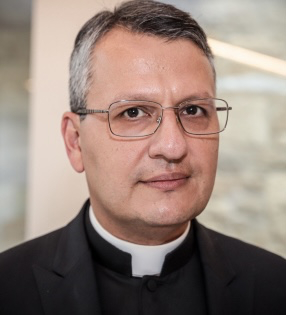
Pope Leo XIV embarked on his fifth international Apostolic Journey since the beginning of his pontificate recently when he went to France. While many hailed the trip as a success, certain Catholic online journals criticized him for “celebrating a motto of the French Revolution used by Freemasons—“Liberty, Equality, Fraternity”—as “universal ethical imperatives.”
The pontiff told the faithful that those words “are not simply words emblazoned on the front of your public buildings; they refer to universal ethical imperatives that also find in the Gospel message an inexhaustible source of inspiration and fulfillment.”
Pope Leo XIV presented a more profound historical and theological inquiry, particularly given that the Masonic organization Le Grand Orient de France has as its motto “Liberté, Égalité, Fraternité,” which originated during the anti-Catholic French Revolution—a period characterized by the persecution of bishops, priests, religious communities, and lay Catholics throughout the Reign of Terror.
Pope Leo XIV presented a more profound historical and theological inquiry.Tweet ThisIn regarding “liberty, equality, and fraternity” to be “universal ethical imperatives” and arguing that they are found in the Gospel as “an inexhaustible wellspring of inspiration and realization,” his methodology may be perceived as an endeavor to reclaim these principles within a Christian framework of human dignity. Nevertheless, the formulation raises the question of whether their secular and revolutionary origins are being sufficiently distinguished from their Christian interpretation, given that these expressions carry multiple competing historical interpretations.
The issue is not whether Catholics are capable of supporting liberty, equality, and fraternity; they are. The issue is the substantive content these terms acquire when presented as universal ethical imperatives. Fundamentally divergent conceptions of human liberty, equality, governance, and the relationship between religious faith and political authority can be expressed through identical terminology, which is most important.
This question becomes still more significant when Leo speaks positively of religious freedom in the French context, which Pope Pius IX, in his encyclical Quanta Cura (1864), rejected the proposition Leo made that “every man is free to embrace and profess that religion which, guided by the light of reason, he shall consider true.” Pius IX likewise condemned propositions asserting an unrestricted liberty of conscience and religion.
Leo did, however, highlight that religious liberty cannot be regarded as a right to choose or to profess if it is not aligned with objective truth. In this, the pope seemed to reproach France’s secularist policy, which ultimately traces back to the French Revolution—that of assuring that there is absolutely no influence of religion in the political affairs of the government. In fact, when Pope Francis celebrated Mass in Marseille in 2023, President Emmanuel Macron, in order to comply with this policy, attended the papal Mass but did not participate in worship, holding that he was only present as president out of respect and courtesy, not as a practicing worshipper.
“The Christian involved in public life, who acts in the light of his conscience enlightened by faith, cannot be considered a proselytizer or a threat to the unity of the homeland,” said Pope Leo.
At first glance, this reflects what Leo did say, however, that religious liberty cannot be regarded as an autonomous right to choose, profess, and propagate religious belief independently of objective truth; the pope seemed to reproach France’s secularism, which ultimately traces back to the French Revolution. Popes Benedict XVI and Francis also shared a social vision for the Catholic Church and its dealings with the secular world: “healthy secularism.”
This concept was first mentioned by Pope Pius XII in 1958 when he recognized the possibility and legitimacy of a “healthy secularity of the State,” a formula that not only accepted the distinction between “secularism” as a social philosophy and “laïcité” as a method of state organization, but also opened, within Catholic thought, a reflection on the role and meaning of the autonomy of the laity in general and of the State in particular.
In other words, given that man has an intrinsic religious orientation since he is “created” in God’s own “image and likeness” (Genesis 1:26-27), the possibility of accepting an agnostic or secular State,—as was during the former Soviet Union or is today in communist China—is out of the question. He also noted the contradictory nature of the expression “secular State” while simultaneously rejecting the “confessional State,” i.e., a State in which civil, political, and economic rights derive from a certain profession of faith.
Given that man has an intrinsic religious orientation since he is "created” in God’s own “image and likeness"… the possibility of accepting an agnostic or secular State…is out of the question.Tweet ThisThe paradox is that he later convened with representatives from Muslim, Jewish, Buddhist, Protestant, and Orthodox faith traditions to commit the Catholic Church to shared spiritual and educational objectives among non-Christian religions. Understandably, one could reasonably argue that the pope acquiesced to principles associated with Freemasonry.
The difficulty comes when religious liberty is taken to mean that each person has the prerogative to decide for himself what is true and to announce that truth independent of objective truth. This is an erroneous position, which Pius IX condemned in Quanta Cura—the doctrine that every man has a free right to embrace and profess any religion he may deem true. The Catholic view of conscience does not make subjective judgment the basis of religious truth. It is committed to the search for truth, which man’s conscience must seek and conform to.
The Catholic view of conscience does not make subjective judgment the basis of religious truth. It is committed to the search for truth, which man’s conscience must seek and conform to.Tweet ThisIt is not correct to say that Leo XIV’s statements (and actions at the gathering with other religions) flatly reject Catholic teaching, for he does not positively affirm the proposition condemned by Pius IX. The positive elucidation of religious liberty, however, raises a legitimate theological concern if read without the qualifications that the traditional Catholic understanding of truth, conscience, and God’s objective rights requires. The heart of the matter is whether religious freedom is understood as the independent human right to determine and profess religious beliefs regardless of their objective truth or as a safeguard against coercion in religious affairs.
The same problem applies to Leo’s classification of “liberty, equality, and fraternity” as “universal ethical imperatives.” Catholicism acknowledges all these principles, but it does not ground them in independent human sovereignty. Liberty must be directed toward the truth, for there is only one truth. Why? Because when one searches for God and one’s purpose for being on this earth, there can be only one truth—one divine Revelation, as taught by the Catholic Church. If and when the Church engages with those outside the fold of Catholicism, it must do so with a clear doctrinal understanding that the fulness of revealed truth is the Catholic Church which was founded by Jesus Christ.
Equality has to be based on the equal dignity of persons created by God. Fraternity ultimately derives from humanity’s common origin and definitive destiny in God. The crucial question, therefore, is not whether these principles are compatible with Christianity but whether their meaning is grounded in Christian anthropology or in the nonreligious political tradition in which they have also arisen.
There are no comments yet.