


The latest social media flare involving Donald Trump and filmmaker Rob Reiner arrived with a predictability that modern political culture has trained everyone to expect. Upon the news of Reiner’s passing from suspected homicide, a sharp post appeared, the tone was dismissive, and the timing coincided with a moment of public mourning connected to Reiner’s family. Immediately, the familiar cycle followed: outrage accelerated, defenses hardened, and the public square once again resembled a shouting match staged not for the good of the republic. Therefore, while many voices rushed either to excuse or to amplify the insult, a more serious question quietly pressed itself upon Christians and social conservatives who wish to shape culture rather than merely react to it.
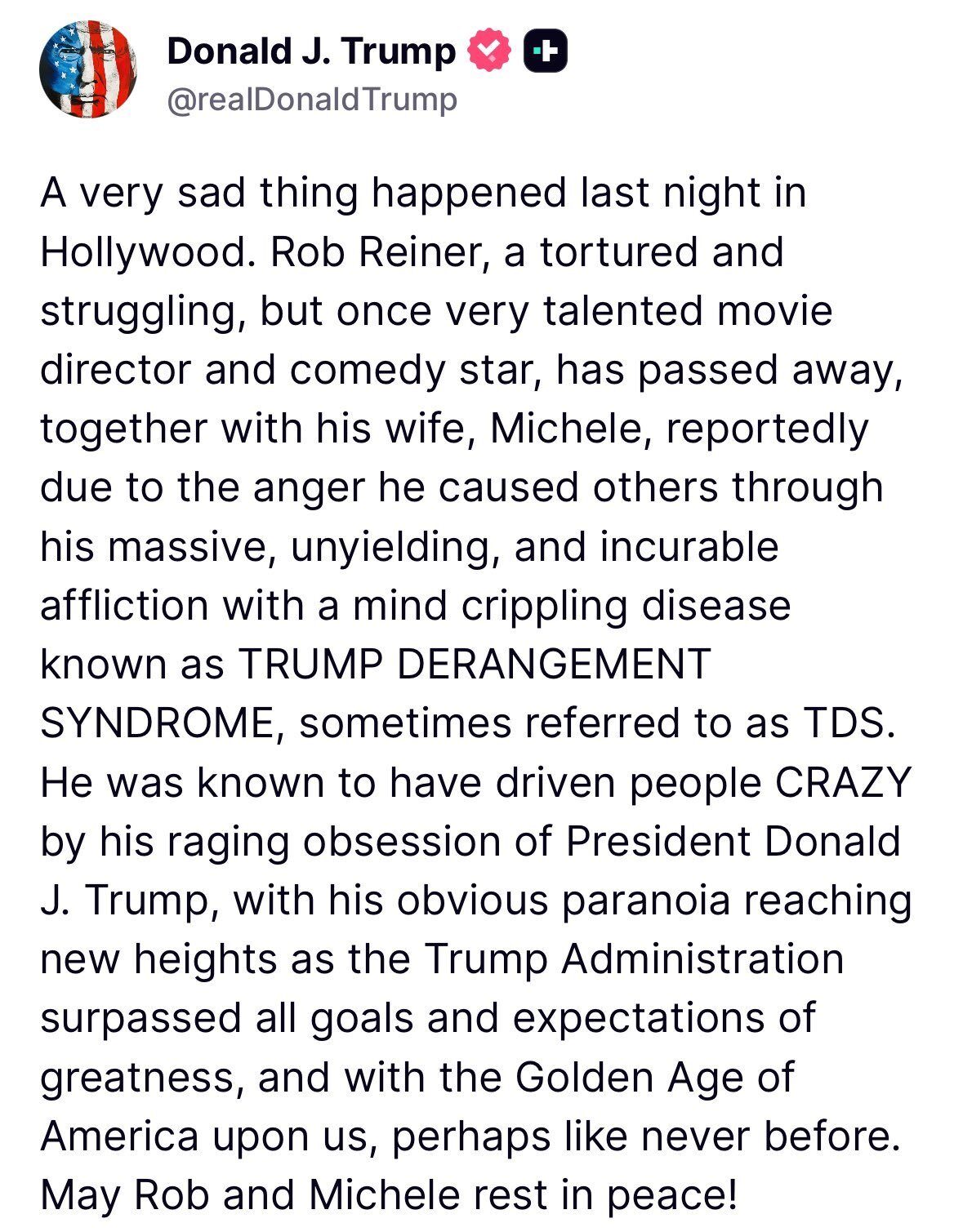
The temptation in such moments involves fixation on the personality at the center of the storm. Donald Trump remains a polarizing figure whose rhetorical style invites reaction. However, a fixation on Trump himself tends to obscure the deeper moral responsibility that rests on those who claim allegiance to Christ while participating in political life. Consequently, the issue here extends beyond partisan loyalty or strategic calculation. The issue concerns witness, virtue, and the manner in which truth enters a fractured culture already fatigued by hostility.
Political life, properly understood, exists to move society toward the good and the true through prudential judgment and moral clarity. Therefore, every public controversy becomes a test of whether one seeks cultural transformation or mere tribal affirmation. When a public figure speaks harshly during a season of grief, even when the target represents ideological opposition, the moment presents an opportunity for Christians to demonstrate a distinct moral grammar. Silence, deranged outrage, or gleeful applause all fail that test in different ways.
Social conservatives often speak correctly about the corrosion of civic norms, the coarsening of discourse, and the loss of shared moral language. Consequently, credibility demands consistency. When one condemns cruelty in progressive rhetoric, one must also condemn cruelty when it appears on one’s own side of the aisle. Otherwise, moral critique begins to sound hypocritical rather than principled, and the watching culture quickly recognizes the dissonance.
This particular episode carried an added moral weight because it unfolded amid mourning. Western civilization, shaped by Jewish and Christian moral imagination, has long recognized restraint toward the grieving as a civilizational achievement rather than a sentimental custom. Respect for the dead and for those who mourn functions as a boundary marker of humane society. Therefore, speaking harshly during such a moment fractures something deeper than political etiquette. It fractures a shared intuition about dignity.
Christians, therefore, possess an obligation that exceeds mere political alignment. The obligation involves modeling a morally superior posture that remains intelligible even to those who reject Christian belief. This posture surpasses the language of taking the high ground, since it concerns leading by witness rather than scoring points. A high-ground posture still plays the game of power. A witness posture quietly exposes a different standard altogether.
The late Benedict XVI once observed that the Church grows through attraction rather than coercion. That insight applies equally to cultural engagement. When Christians respond to provocation with measured truth, restrained speech, and visible charity, they reveal an alternative mode of social existence. Consequently, moments like this present openings rather than obstacles. They reveal how Christians might bridge the vitriolic divide without surrendering moral clarity.
The disappointment surrounding this episode emerges precisely because precedent exists. When Justice Ruth Bader Ginsburg passed away, Donald Trump offered public words of respect that surprised many observers. That moment demonstrated that restraint, honor, and civic decency remain possible even amid fierce ideological disagreement. Therefore, expectations were shaped accordingly. A similar response in the present case could have signaled continuity with that earlier gesture, reinforcing the possibility of humane politics within a polarized age.
When Justice Ruth Bader Ginsburg passed away, Donald Trump offered public words of respect that surprised many observers.Tweet ThisRecognition of that earlier good matters, since gratitude forms part of civic morality. A refusal to acknowledge past virtue cultivates cynicism rather than wisdom. Therefore, disappointment here carries meaning precisely because better was previously shown to be possible. Christians should feel free to say so without descending into theatrical outrage or partisan hysteria.
Benjamin Franklin, whose moral instincts were shaped by both classical wisdom and biblical imagination, allegedly wrote that “The best thing to give your enemy is forgiveness; to an opponent, tolerance; to a friend, your heart.” The wisdom of that line rests in its social realism. Forgiveness disarms cycles of retaliation. Tolerance preserves space for civic coexistence. Charity strengthens bonds where trust already exists. Consequently, public discourse ordered by such virtues resists cultural decay even amid conflict.
Social media, however, rewards a different set of incentives. It rewards immediacy, indignation, and performance. Therefore, Christians who allow their reactions to be shaped primarily by digital outrage risk absorbing the very habits they claim to oppose. Over time, such habits deform moral perception, making cruelty appear justified and restraint appear weak.
Virtue in social conduct shapes culture more profoundly than any single policy victory. Laws matter, elections matter, and institutions matter. However, the moral tone of public life ultimately conditions how those structures function. A society trained to relish humiliation eventually corrodes trust. A society trained to practice restraint preserves the possibility of persuasion.
For Christians, this insight flows directly from the Gospel. Christ’s authority emerged through truth spoken in love, through silence before accusation, and through mercy extended even under mockery. Consequently, political engagement detached from that pattern risks becoming an imitation of power rather than a participation in redemption.
Condemning ill-timed or harsh speech during moments of grief remains entirely compatible with pursuing broader political goals. One may affirm policies, appreciate past achievements, and still call for greater consistency of virtue from those in leadership. Indeed, such consistency strengthens rather than weakens long-term cultural influence. Leaders benefit from moral correction offered without hysteria, and supporters mature through disciplined discernment rather than reflexive defense.
The danger lies in allowing emotional volatility to eclipse purpose. When Christians become consumed by outrage cycles, the horizon of political life shrinks. Every controversy becomes existential, and every misstep becomes totalizing. Consequently, the slow work of cultural renewal recedes behind a fog of perpetual reaction.
The culture remains Christ’s to save and the Church’s to evangelize. That mission continues regardless of the latest social media post or news cycle. Therefore, Christians would do well to remember that their public responses form part of their proclamation. Every word spoken online trains the heart either toward virtue or toward vice.
In moments like this, the call remains clear. Speak truthfully, refuse cruelty, affirm dignity, and maintain focus on the good toward which political life aims. Such discipline neither excuses error nor inflates it beyond proportion. Instead, it witnesses to a moral vision capable of healing rather than deepening division.
Through restraint, clarity, and charity, Christians demonstrate that they remain different. Through that difference, culture encounters something unexpected. Through that encounter, transformation becomes possible even amid social uproar stirred by another thoughtless post.
“Missed the Mark” would be a fitting title for some editorial self-reflection. You’ve devoted your attention to parsing Donald Trump’s remarks about a horrific but isolated crime, while New York, under Governor Hochul, is advancing legislation to legalize physician-assisted suicide. This represents an irreversible shift in law that directly contradicts Catholic moral teaching and places the most vulnerable at grave risk.
The disparity in focus is striking. A Catholic publication should prioritize confronting state-sanctioned killing over critiquing political rhetoric, especially when the former constitutes a systemic moral rupture with lasting legal and cultural consequences.
One is left to ask whether scrutinizing Trump’s tone or rhetoric is simply a safer target, one that aligns more comfortably with prevailing elite media narratives, than directly challenging Democratic governance on life-and-death policy. If so, the result is not moral clarity but moral selectivity.
When rhetoric eclipses law, and commentary displaces confrontation with grave injustice, a publication risks losing its prophetic voice. In that sense, Crisis itself appears to be in crisis.
I will put Crisis Magazine’s 40+ year history of directly challenging anti-Catholic and anti-life initiatives against any other publication. The idea that somehow we take the “prevailing elite media narrative” is easily disproven by mounds of evidence on this site.
But we also are willing to challenge our own “team” when it’s required, and the fact that so many seem to implicitly defend Trump’s uncharitable and awful statement by just saying “but why don’t you talk about X!” (which isn’t an argument, of course), shows that there is also a crisis within our ranks that needs to be addressed and we’re unafraid to do that.
Thank you for the response. I don’t dispute Crisis Magazine’s long history of confronting anti-life and anti-Catholic initiatives. My concern is narrower: editorial prioritization and an emerging pattern of emphasis, not institutional legacy.
This isn’t a defense of Trump’s rhetoric. It’s a question of moral proportion. Parsing a political figure’s tone in response to an isolated crime does not carry the same gravity as the advance of physician-assisted suicide, which represents a structural and irreversible assault on the sanctity of life.
Raising that distinction is not “whataboutism”; it;s a hierarchical moral argument, one the Church itself insists upon. Of late, the emphasis appears disproportionately critical of Trump while Democratic governance advancing grave moral evils receives less immediacy. That imbalance risks misordering moral priorities and diluting the Church’s prophetic focus. My question, respectfully raised, was not about a crisis “within the ranks,” but about maintaining moral coherence in a moment that demands it.
Domenic,
You are absolutely correct that something like physician-assisted suicide is a far worse evil than an uncharitable remark by the President. However, no one who reads Crisis is tempted to support physician-assisted suicide, yet many might justify Trump’s remarks even though they were morally wrong. Yes, we need to continually make clear our arguments against our society’s worst moral evils, but we shouldn’t overlook those evils that can impact us individually.
Also, we encourage submissions, so please feel free to submit an article on what’s happening in New York for our consideration.
God bless,
Eric
Our liberal priest refuses to acknowledge nor pray our government officials since the last election with no mention of the assassination attempt.
Maybe not an appropriate comment, especially so soon after the murders.
But also, not nearly as bad as the many, many comments by liberals about Charlie Kirk (and his wife) right after he was assassinated.
Yes….not the best. But a truth by a man with a bullet wound to the head. Reiner was awful and all the bullets flying whether at our kids at Mass in Minneapolis, Kirk and Trump are inspired by men of power like Reiner. The instability of his ideology killed him and his wife too. Classic sins of the father.
I wish he had not said it, but evoking moral superiority when we have no bullet holes is not much better.