

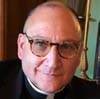
This is a sermon delivered by Fr. John Perricone at a First Mass of Fr. Joseph Falciano, FSSP, on June 10, 2026, St. Josaphat Oratory, Bayside, Queens.
Little over a week ago, Fr. Joseph laid upon the sanctuary floor of St. Cecilia’s Cathedral in Omaha, Nebraska. He lay there like a corpse, outstretched with face upon the floor. While immobilized by this prostration of abandonment, the Solemn Litany of the Saints rolled over his ears like the gentle waves of the ocean.
Then a remarkable moment came. He rose to his feet and knelt before a Successor of the Apostles, who then laid his hands upon his head. At that instant, the heavens opened and the Holy Spirit leapt down from His throne, as at Pentecost. The Divine Comforter then breathed new life into him.
Joseph Falciano ceased to be.
And Fr. Jospeh Falciano appeared.
He was literally a New Creation.
You would not be remiss in being reminded here of the Book of Genesis, in its opening chapters. There, God took the dust of the earth and breathed upon it. And Adam appeared.
Nor would you be wrong in remembering the first Easter night when the Apostles were gathered in the Upper Room. Our Lord proceeded through the locked doors and breathed upon them, saying: “Receive the Holy Spirit.”
On Fr. Joseph’s ordination day, it was a single breath from God, and there came forth a New Creation, one that the world had never seen before. In him, there appeared upon this earth supernatural powers new to the entire universe. These powers were startling and breathtaking.
Nothing would ever be the same again. “Behold, I make all things new” (Revelation 21:5).
Indeed, every priest is a New Creation, and the fire of the Holy Spirit emblazons upon his soul an indelible mark remaining even unto eternity.
Adding to the piercing drama of the Ordination rite is one more stunning ceremony. The ordinand, still reeling from the world-changing imposition of hands, once again approaches the Successor of the Apostles. He who stands in the direct line of Sts. Peter and Paul then takes Sacred Chrism and soaks the palms of the new priest’s hands. An attendant then assists the bishop in wrapping a long linen cloth (maniturgium) tightly about the ordinand’s chrism drenched hands. The newly-minted priest appears to all like some kind of captive.
He is. He is now a captive to Christ and Christ alone.
Only a priest enjoys the powers that can bring God to the world. Some of the unordained try to mimic his sacred functions. They remain only mimicry.
The premonitory words of St. John Mary Vianney immediately come to mind: “When the priest is a saint, his people will be holy. When the priest is merely good, his people will be bad. When the priest is bad, his people will be beasts.”
“When the priest is a saint, his people will be holy. When the priest is merely good, his people will be bad. When the priest is bad, his people will be beasts.”Tweet ThisOur world has become a place of beasts.
Only the priest possesses the supernatural powers to wrestle those beasts and render them helpless.
Only the priest can turn around souls who have made fateful alliances with the beasts.
Only the priest can give succor and strength to those whom Heaven desires to fight the beast.
Only the priest can give supernatural hope to war-weary little ones. Though the fight be long, marked by defeat after defeat, the victory will be ours. For our King and Lord promised of His Holy Catholic Church that “the gates of Hell shall not prevail against it” (Matthew 16:18).
On Fifth Avenue in New York City, across from St. Patrick’s Cathedral, there stands the mythological Atlas bearing the world upon his arms. It represents the height of ancient Greek hubris, mirroring the same hubris of the Tower of Babel.
But that rendering of Atlas today represents the denouement of the secularist experiment. It is the tragic cry of Nietzsche that God is dead and man is God.
The priest shouts to the world, clothed in the battle raiment of the summoning Roman black cassock, that only God is God, and man is His creature.
Only the priest carries the world—because he is Alter Christus, one of the Dispensatores Mysteriorum Dei (1 Corinthians 4:1).
He alone is the bridge over which man climbs to God.
Without the priest, there is only the enveloping chaos.
Perhaps at best this may be true for a Priest from & in traditional Catholicism though I am not so sure that this is equally (even remotely) true in the modern Church.
“’When the priest is a saint, his people will be holy. When the priest is merely good, his people will be bad. When the priest is bad, his people will be beasts.’”
“Our world has become a place of beasts.”
This is the tragic state of things now in our Church and consequently in the world. The culminating evidence of this fact is the shocking and pathetic Synod Report # 9 attempting to sanctify sodomy (the sin that cries out to heaven for vengeance)that just came out of the Vatican.