

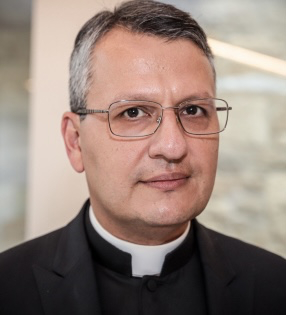
At least three people were killed and several others were injured after the Holy Family Church in northern Gaza—the only Catholic Church there—was hit by an Israeli strike on Thursday morning. Among the injured was the parish priest, Fr. Gabriel Romanelli.
The church was sheltering civilians, including a number of children with disabilities, according to Fadel Naem, acting director of Al-Ahli Hospital, which received the wounded. Others injured included one child with disabilities, two women, and an elderly person, Naem said. This is not the first time the Israel Defense Forces (IDF) targeted a church.
On October 19, 2023, just twelve days after the October 7 attacks, the IDF bombed the nearby fifth-century church of St. Porphyrius, Gaza’s most ancient—also considered the third oldest church in the world. At least eighteen people were killed, including two Catholic women.
Nahida Anton and her daughter Samar Anton were fatally shot on December 16, 2023 by the IDF as they walked to the convent of the Missionaries of Charity within the complex of the aforementioned Holy Family Parish. Samar was killed while she was trying to carry her mother to safety. The IDF also destroyed the convent, which was believed to be sheltering 300 people. The Latin Patriarch of Jerusalem, Cardinal Pierbattista Pizzaballa, said they “were shot in cold blood inside the premises of the parish, where there are no belligerents.”
The Latin Patriarch of Jerusalem, Cardinal Pierbattista Pizzaballa, said they “were shot in cold blood inside the premises of the parish, where there are no belligerents.”Tweet ThisThe IDF denied that the church was the target of the attack while confronting Hamas militants. However, as stated by Diana Tarazi, a 38-year-old Palestinian Christian: “The missile fell directly on it. We cannot believe that the church was not their aim.”
The Christians of Gaza—as in the rest of the Holy Land—date back to biblical times, when Philip the Apostle travelled down the desert road from Jerusalem to Gaza to spread the Gospel message (Acts 8:26). Ironically, their persecution in the Holy Land also dates back to the inception of Christianity with the death of Jesus Christ Himself at the hands of the Sanhedrin—an elite council of priestly and lay elders.
The Sanhedrin arrested Jesus during the Jewish festival of Passover for the crime of blasphemy, that is, referring to God as His Father (Matthew 26:63-66; Mark 14:61-64; Luke 22:67-71). And thus, He was accused of “making Himself God” (John 10:30-33). While the Romans were the ones who materially crucified the Lord, He was brought to Pilate by the Jews because only the Roman authorities could carry out this type of capital punishment. And it was not just the Jewish body politic that demanded the crucifixion of Christ; the crowds of Jerusalem also demanded it when they shouted: “Crucify Him! Crucify Him!” (Matthew 27:22-23; Mark 15:13; Luke 23:21).
This is the reason why the first and closest followers of Christ, the Apostles, hid in the Upper Room, for “fear of the Jews” (John 20:19). In fact, as per the Catholic calendar, on December 26, the day after most of the Christian world celebrates the birth of Christ, the Church observes the martyrdom of St. Stephen the Protomartyr who was stoned by the Jews for bearing witness that Jesus is the Messiah (Acts 6:8-10, 7:54-60).
Christians, as per official British Mandate statistics, had accounted for 9.5 percent of the total Palestinian population in 1922; it dwindled to 7.9 percent in 1946. Over the course of the Palestinian War of 1947-1949 that was fought between the Palestinian Arabs and the Palestinian Jews, a large number of these Christians—as part of the Arab community—were coerced to leave or were expelled by Jewish militants from what would become recognized as Israeli territory following the Armistice Agreements of 1949.
Jump forward to 2009: there were an estimated 50,000 Christians in the Palestinian territories, mostly in the West Bank, with about 3,000 in the Gaza Strip. Since the present-day war began on October 7, 2023, the 1,000 to 1,200 Christians in Gaza have diminished to between 600 and 700, according to Khalil Sayegh, a Palestinian Christian and political analyst who lived in Gaza until 2009.
Most of the Christians who have left for Egypt since the beginning of the war do not want to return. Those who stayed returned to their homes in the north during the two-month ceasefire that began in January.
Gazan Christians also face challenges from Hamas Islamization. According to Ihab Hassan, a Palestinian Christian and human rights activist based in Washington, D.C., the militants have endangered the Christian community by, for example, falsely claiming that they collaborated with Israel on social media to drop Gospel fliers from planes into Gaza—hence the crime of proselytizing.
The Tazpit Press Service—an independent Israeli news agency—reported at the beginning of December 2022 that 12 percent of Gaza’s population has fled the Strip since Hamas seized control of the Strip in 2007—the desire of Gazan Christians to emigrate is twice as strong as that of the Strip’s Muslims.
They cited corruption, poor economic and living conditions, and, above all, discrimination—sometimes violent—on religious grounds: 25 percent reported religious discrimination in job interviews, while 30 percent said that they were subjected to expressions of hatred for being Christian; one-quarter of the Palestinian Christians told the pollsters that Muslims suggested they convert to Islam, while Christian women experience harassment and pressure to cover their hair and adopt Islamic forms of attire.
In addition, 70 percent said that, at least once in their lives, they heard from Muslims that Christians’ judgment is to burn in Hell. In general, Christians are made to feel like second-class citizens, despite their Palestinian patriotism and historical affinity to the land—emphasizing both solidarity with Palestinian Muslims resisting Israeli occupation and compassion for civilians impacted by the conflict.
After the strike on the church in Gaza City, Italy’s prime minister, Giorgia Meloni, called the Israeli attacks on civilians in the strip “unacceptable,” adding that “no military action can justify such conduct.”
In a telegram signed on Pope Leo XIV’s behalf by the Vatican Secretary of State, Cardinal Pietro Parolin, the pontiff expressed his “deep sadness” and renewed “his profound hope for dialogue, reconciliation, and lasting peace in the region.”
Unfortunately, so long as the Israelis continue to get full political and military backing from the United States, not only will the ethnic cleansing in Gaza continue but the situation of our Christian brethren in the Holy Land will worsen.
I think it would be fair to mention that Israel denied targeting the church and fair to mention that the parish priest did NOT say the December 2023 sniper was Israeli and fair to mention that the patriarch of Jerusalem who did say the sniper was Israeli also could not explain why he thought the sniper was Israeli. I also think your use of Bible verses condemning the Jews has nothing to do with present day Jews and has no place in this issue.
This is something of a strange article. Paragraph after paragraph lists muslims mistreating Christians, and then the last paragraph laments “the ethnic cleansing (by Israel) in Gaza.
Good point. The article doesn’t support that conclusion at all.