Why “Rich Men North of Richmond” Resonates

A week ago, no one had heard of Oliver Anthony or his song, “Rich Men North of Richmond.” Now he’s a celebrity and “Rich Men” is the #1 song in the country, with the music video having already reached 17 million views on YouTube. Why has this song gone so viral? Why is it resonating with so many people? Because it taps into the deep discontent so many Americans feel today about the direction of our country; it expresses what many believe but don’t know how—or are afraid—to say.

If you haven’t listened to the song, do so now (parental note: it does contain a few curse words). It’s a powerful piece musically and Anthony sings with clear passion, but it’s the lyrics that make the song the sensation it is.

Anthony begins,

I’ve been sellin’ my soul, workin’ all day / Overtime hours for bullsh*t pay / So I can sit out here and waste my life away / Drag back home and drown my troubles away.

Simply put, the American Dream for so many people has become the American Nightmare. For generations there has been an unwritten understanding if one works hard and is responsible, he’ll live a decent life and, more importantly, he’ll leave his kids in better shape.

That’s no longer true. With an economy tottering on collapse and rampant inflation (which Anthony will get to a little later), Americans often live to work rather than work to live. We feel as if we are cogs in a machine we don’t control but can’t escape. Our hard work enriches the elite class, but does little to advance our own state in life.

Livin’ in the new world / With an old soul /

This is perhaps the most poignant line in a song full of them. We all understand that we now live in a “new world.” Those of us old enough to have lived in the 20th century know, to the core of our being, that things are different now. If you have an “old soul,” one that longs for the true, the beautiful, and the good, you feel as a fish out of water, a man without a country.

Of course, the elites will take this legitimate longing for “the good ol’ days” and weaponize it against the common man, accusing him of racism. “This is just a dog whistle that you want to go back to a racist past where the white man reigned supreme.” It’s nothing of the sort, of course. It’s a desire to return to the Real, when reality wasn’t an enemy to be defeated or conformed to our most base desires.

And the accusations of racism only further the frustration felt by the “old souls.” When someone dares express that perhaps things today are “off,” he’s immediately silenced by being branded a bigot or mysoginist or other hate term.

These rich men north of Richmond

For those who aren’t clear already, the “rich men north of Richmond” are the elite class, primarily politicians, residing in Washington, DC (which is just north of Richmond, VA). And note that Anthony isn’t singling out one political party or the other: it’s all the politicians who are the problem. They are all hypocrites and corrupt and don’t care about us. They send billions of our dollars to far-away conflicts while doing little to help those in need here in America. In fact, they are happy to send the lower class’s sons and daughters to die in those conflicts if it means they enrich themselves and their buddies in DC.

Anthony isn't singling out one political party or the other: it's <em>all</em> the politicians who are the problem. They are <em>all</em> hypocrites and corrupt and don't care about us.Tweet This

Lord knows they all just wanna have total control / Wanna know what you think, wanna know what you do

What do the “rich men of Richmond” want more than anything? To control you. We saw that during the Covid lockdowns, when mom & pop shops and churches were forced to close, but big box stores, who have lobbyists in DC and state capitals, were deemed “essential services.” As always, the rich get richer.

But even beyond the lockdowns, the Woke Regime is the elite’s attempt for total control. Did you once express an unacceptable thought? You will be punished. Are you part of a demographic deemed “privileged?” You will be silenced. Again, total control.

‘Cause your dollar ain’t sh*t and it’s taxed to no end / ‘Cause of rich men north of Richmond.

Anthony might not know anything about the Federal Reserve and how our money is manipulated, but he understands its impact: “the dollar ain’t sh*t.” U.S. monetary policy for the past century has punished savers and rewarded spenders. If you live a meaningless existence of consumption, you are the star student of our economic masters. But if you want to save for your future and your children’s future, you are declared an enemy of the people.

Politicians on both the left and the right love to tout the health of the economy when the stock market rises. But it’s a shell game. They inject more and more money into the system, which inflates all prices, including the prices of stocks. But you know what doesn’t rise anywhere near as fast? Your wages. Combine that with onerous taxes, and even the most hard-working man can’t get ahead in this system.

I wish politicians would look out for miners / And not just minors on an island somewhere

To add insult to injury, while the rich men north of Richmond make our lives harder and harder, they live corrupt lives that would make the Borgia blush. Anthony alludes to the Jeffrey Epstein scandal, in which many of the world’s elites would allegedly gather on his island for hedonistic practices, including the sexual abuse of minors. There used to be at least the illusion that our politicians were there to serve our country, but now they don’t even bother with the illusion: they are there to serve themselves, on our backs.

Some have criticized this song for being hopeless—a depressing song that only laments our problems. But that’s the point: people are feeling hopeless, and the way we are supposed to change things—our democratic political system—is clearly so corrupt that there seems to be no way to fix things. All we can do is sing dirges for our fallen nation.

The popularity of this song should be taken seriously. Why? Because, frankly, it sounds like a prelude to a revolution. History has shown that when a people are continually pushed down while their elites live lives of corrupt hedonism, pressure builds to dangerous levels. Sadly, the answer of many elites to the people’s discontent is to just push down more. Eventually, however, the pressure becomes so great that an explosion happens.

When that occurs, the rich men north of Richmond better watch out.
Why So Critical?

Astute readers might notice that Crisis ran two articles today criticizing World Youth Day. This is in addition to last week’s podcast about the event that was also mostly critical. So a fair question to ask might be: Why is Crisis so negative about an event that brings hundreds of thousands of young people together for the purpose of proclaiming the Catholic Faith?

We often hear complaints like this whenever we are critical of “positive” events in the Church, particularly popular ones like WYD. In an era of scandal, heresy, and corruption, is it really worthwhile to find fault in those things that appear to be doing good in the Church? Are we just looking for problems and refusing to see the good?

I would simply respond that a main reason the Church is in the (poor) shape she’s in is because Catholics have long accepted a status quo that doesn’t work. And that includes the status quo of glossing over negligence in liturgical matters, sacrificing sacredness in a misguided effort to attract young people, and pretending that programs will save the Church. We justify these actions by claiming they are necessary (perhaps even necessary evils) in order to proclaim the Gospel in the modern world. But have we stopped to consider that it’s perhaps those very actions which are hindering the spread of the Gospel?

That’s not to say there isn’t a danger in being critical. One can refuse to see the good happening in the Church. We can strain out the gnat and swallow the camel. But if we refuse to be self-critical in matters as important as how we treat Our Lord in the Blessed Sacrament, then we’ll continue to accept a status quo that’s seen millions leave the Church in the past few decades. If we shy away from any and all criticism because it seems “negative” or will bring about division, then we are no more than a political party with no underlying core beliefs.

I’m sure the Lord touched many lives at WYD this year. I’m sure that many, if not most, of the people who went were sincere in their desire to glorify God and had nothing to do with how Our Lord was treated by the organizers. Yet we are not called to give God our “hopefully good enough,” but instead our best, and until we do that, we can and should be self-critical about our status quo, including the sacred cow that is World Youth Day.

We commend every Church leader who is working tirelessly to bring people to Christ and His Church. But we must realize that good intentions are not enough; we need to learn from our mistakes and also learn from our predecessors in the faith on the best methods for doing that important work.

A Movie Isn’t Worth Sinning Over

This past weekend saw the release of two major movies, Barbie and Oppenheimer. The juxtaposition of these two very different movies launched a debate on social media: Are you Barbie or are you Oppenheimer?

Catholics should be neither.

The Barbie movie is unsurprisingly woke, anti-man trash. The unrelentingly message of the movie is that men are always dumb and/or evil, and women are always smart, independent, and right. Since its creation, the Barbie franchise has managed to combine both misogyny and feminism into one plastic package. I have six daughters, and it would be a dereliction of fatherly duty if I ever encouraged them to play with Barbies. It’s a no-brainer that Catholics should not support Barbie.

But Oppenheimer is unacceptable for different reasons; in fact, I’d argue it’s actually sinful to watch. I’m a huge fan of Christopher Nolan, the director of this historical piece on the development of the atomic bomb. When the movie was first announced, I planned to see it. However, I found out this weekend that the movie contains sexual scenes that contain nudity. Another no-brainer: no Catholic should watch Oppenheimer.

This take is surprisingly controversial among Catholics. Over the years I’ve been surprised to see how often Catholics, even ones who promote orthodoxy (including orthodox morality), will encourage people to see movies with nude sex scenes. This is baffling, because it’s always a sin to watch such a scene. Always, full stop.

When you take this absolutist stand, you get serious pushback among Catholics. It’s expected from liberal Catholics, who are always seeking to diminish sin and its impact. But it’s surprising coming from more conservative Catholics. They will argue that nudity has been represented in great art in the past, or that one can watch such scenes without getting aroused, or that the movie is much more than just that one scene.

All of these are excuses.

There’s a great difference between seeing Michelangelo’s David and watching two naked people engage in intimate relations. To make this clear, imagine asking a decently-formed Catholic of Michelangelo’s time, “Do you think it’s a sin to watch two people fornicate with each other?” The person would likely think you are the devil himself for just asking the question. But we’ve become so desensitized to this particular sin that we diminish, even deny, its intrinsically evil nature.

The Catechism of the Catholic Church states:

Pornography consists in removing real or simulated sexual acts from the intimacy of the partners, in order to display them deliberately to third parties. It offends against chastity because it perverts the conjugal act, the intimate giving of spouses to each other. It does grave injury to the dignity of its participants (actors, vendors, the public), since each one becomes an object of base pleasure and illicit profit for others. It immerses all who are involved in the illusion of a fantasy world. It is a grave offense. Civil authorities should prevent the production and distribution of pornographic materials. (#2354)

Note that there are no exceptions for “it’s artfully done” or “it’s in an otherwise great movie” (also note that nude sex scenes in any movie would be classified as “pornography” as the Catechism defines it).

Likewise, one does not have to be aroused watching such a scene for it to still be sinful. Even if not aroused at the time, putting those images in one’s mind can lead to later temptations. Further, if I killed someone but took no pleasure in the act, I still sinned. The morality of an act does not depend upon my emotional response to it. Even a eunuch should not watch other people engage in sexual relations.

It should be remembered that the actors themselves are dehumanized when they engage in—and we watch—these scenes. As the Catechism states, “It does grave injury to the dignity of its participants (actors, vendors, the public).” To watch such acts is to sin against its participants, even if it does not lead one into temptation.

And to say the movie is much more than just that one scene reveals the real reason many Catholics try to defend watching movies like Oppenheimer. They are so scared of being too outside the culture that they willingly sacrifice their integrity rather than be seen as uncool or weird. Sometimes they will even defend their choice by saying we must be knowledgable of the culture in order to evangelize it.

[Catholics] are so scared of being too outside the culture that they willingly sacrifice their integrity rather than be seen as uncool or weird.Tweet This

Nonsense. There is literally no movie ever created that a Catholic must see, and one can still engage with non-Catholics without knowing the latest pop culture references. In fact, by avoiding those evil influences, one is better able to evangelize.

Catholics, do not sell your morality for a Hollywood-spoiled bowl of sin. Treat a movie that has even a single nude sex scene as you would a drink with even a single drop of poison in it: avoid it. If a movie has a sexual scene with nudity, no matter how brief and no matter how good the movie otherwise might be, don’t see it. It’s not worth your soul.

Is a Canceled Priests TLM Network a Good Idea?

A new organization called Protect Our Priests was recently launched that will “defend and preserve the Latin Mass by helping canceled TLM communities continue to have access to the Traditional Mass and Sacraments. We will do this by linking these communities with priests who are able to offer private services.” Essentially, it will pair up canceled TLM communities with canceled priests to create a network for providing the Sacraments in the traditional rite where they are not currently available.

Even though this news story just came out yesterday, I’ve already seen strong reactions—both positive and negative—from Catholics. I’ll admit that I have conflicted feelings about this project.

On the one hand, this organization seeks to correct two grave injustices that currently exist in the Church. Too many good priests have been canceled by their bishops without just cause. These priests are good men who desire to live out their priestly vocations, but have been removed from public ministry without canonical recourse and often even without a reason given. Bishops have abused their authority in order to sideline priests whose open orthodoxy makes them uncomfortable.

Likewise, the Traditionis Custodes era has seen the unjust shuttering of traditional Latin Mass communities. Faithful Catholics who want only to live out their faith like their ancestors did (something that all Catholics once desired) are told that what they are doing is dangerous and needs to be eliminated from the life of the Church. The spiritual harm done to them is incalculable.

So Protect Our Priests does seem to be making a noble attempt to right two wrongs. But I can’t help but be concerned by this effort. 

First, there are dangers whenever Catholics step outside normal canonical boundaries. I recognize that Protect Our Priests sees its network as a response to an “emergency situation” which Canon Law does recognize (it’s a similar argument used by the Society of St. Pius X [SSPX] for its existence). But the reality is that these Masses will be outside the approval of the local bishop, which leads to a canonically irregular and thus potentially dangerous (spiritually speaking) situation. 

As Catholics we should always appreciate the importance of being under a bishop, even when that bishop is not fulfilling his role. The episcopate, after all, is of divine institution. Unlike much of today’s Vatican and diocesan bureaucracy, diocesan bishops are necessary to the structure of the Church. To go outside their authority is a dangerous game. 

Even the SSPX recognizes this. In my interview with James Vogel, a spokesman for the Society, he recognized that their canonically-irregular situation is not ideal and should not be permanent. The Society still emphasizes the importance of the papacy and the local bishop (and recognizes the current occupants of those offices as valid), even when acting outside their jurisdiction.

A more independent group like Protect Our Priests, however, might not be able to resist the pull to fall further and further outside canonical boundaries. An “emergency situation” can be used to cover a multitude of abuses (see what happened in the political world during the Covid “emergency”). Without any episcopal oversight, what will keep the priests in the network on the straight and narrow?

My greatest concern is that the combination of a community with no real oversight and members of that community who are often people who have been spiritually harmed by the Church in the past will be a recipe for potentially greater abuse. In reaction to the loose morality and rules found in many regular diocesan parishes, there could be a pull to become reactionary, forcing a multitude of rules and regulations on the congregation that go far beyond Catholic morality.

Likewise, the possibility exists of a cult of personality rising around a priest. In a small isolated community, a priest who is seen as a persecuted martyr for the truth will be (often rightly) admired, but with no real episcopal oversight, that could lead to an unhealthy attachment to that priest. Community members might feel drawn to treat the words of the priest as gospel, no matter what those words might be.

In a small isolated community, a priest who is seen as a persecuted martyr for the truth will be (often rightly) admired, but with no real episcopal oversight, that could lead to an unhealthy attachment to that priest. Tweet This

So again, I admit I have concerns about this new organization. But ultimately we need to realize that the problem isn’t Protect Our Priests, but the situation that caused the need for the network in the first place. If bishops didn’t unjustly sideline good priests, and if the pope wasn’t on a jihad against traditional Catholics, there would be no market for such a network. While I might not be enthusiastic about this idea, I reserve my greatest concern for the hierarchs that led to its creation.

Be Angry

I’m angry, and if you’re paying attention, you should be too.

The past week has not been a good one for the cause of orthodoxy in the Church. Last week’s appointment of Archbishop Víctor Manuel Fernández as head of the Dicastery for the Doctrine of the Faith was a blow to anyone who cares about souls. Statements by Fernández since the appointment have only amplified how wholly unqualified the man is to be the Church’s guardian of doctrine.

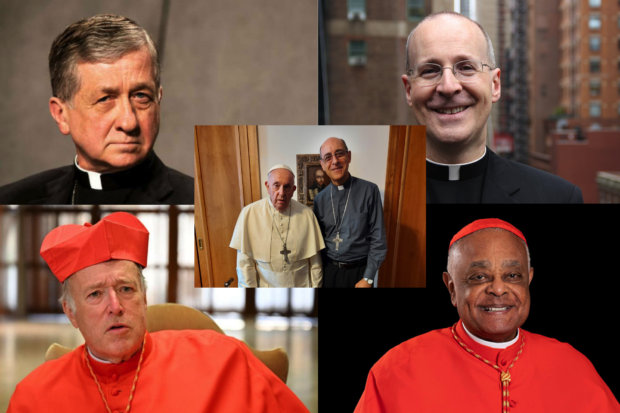
Then yesterday another blow came. The participants in the upcoming Synod on Synodality were announced, including the papal selections. These latter picks are the men whom Pope Francis personally thinks are important to attend and vote on matters of grave importance to the Church. Among his selections from America are Cardinals Cupich, Gregory, and McElroy—confirmed progressives who have shown a willingness to jettison Church teaching for their own ideologies, as well as a disdain for traditional Catholic teaching and piety. They are card-carrying members of the McCarrick wing of the American hierarchy.

But those three men aren’t even the worst papal selections. No, that honor belongs to Fr. James Martin, SJ, promoter of all things gay. That’s right, the most infamous priest in America, the man who has done more to promote homoheresy in this country than anyone else, was selected by Pope Francis as a voting member of the upcoming Synod which will be addressing issues related to homosexuality.

Like I said, you should be angry, at least if you care about souls.

Now, it’s not fashionable in respectable Catholic circles to be angry, or at least to admit it. Doing so will label you a “mad trad” or some other epithet. After all, we are supposed to be joyful witnesses, right? We won’t convert anyone if we are sourpusses. Over and over we are told by professional Catholics that we must never be angry, that somehow it would be unchristian or at least in bad form.

Yet Our Lord got angry at times, and if it’s good enough for him, it’s good enough for us. And what most angered him? It was when religious leaders did things to scandalize the faithful and pull them away from God. When they proclaimed to be leading people to God but then said and did things that were contrary to his Father’s Will. This angered him greatly.

That is the situation we are in now. We have religious leaders—up to and most definitely including Pope Francis—who are actively working to undermine the Catholic Faith as handed on to us by our ancestors. They are sowing confusion among poor souls who often know no better and thus will go down a path that leads to eternal destruction. If this doesn’t cause some righteous anger in your heart, then I question your love of God.

We have religious leaders—up to and most definitely including Pope Francis—who are actively working to undermine the Catholic Faith as handed on to us by our ancestors. Tweet This

That being said, we cannot let anger rule and control our hearts. Yes, be angry, but make sure it is a righteous anger. Be sure it is not an anger that disturbs your peace. That means it also includes a complete trust in God—a trust that He is also angry and He will act in His time. He loves the souls being led astray even more than we do, and although He may seem silent now, He does not abandon His people. I would recommend meditating on Ezekiel 34, in which the Lord condemns evil shepherds and promises that He will save His sheep Himself.

So let us be angry, and in that anger work against the machinations of unholy men who seek the destruction of souls. But in our anger let us trust completely in divine providence and that Our angry Lord will work even through the evil around us for the good of His Kingdom. 

“Be angry, and sin not” (Eph 4:26).

Personnel is Policy

This week saw two more Vatican scandals in a long line of scandals during the Francis papacy. On the surface they appear unrelated, but in reality they are examples of the same underlying problem. 

The more serious scandal of the two is that Pope Francis appointed Archbishop Víctor Manuel Fernández as the new Prefect of the Dicastery for the Doctrine of the Faith—essentially, the Church’s doctrinal head. Who is Fernández? He is the ghostwriter of the doctrinally problematic Amoris Laetitia and also the author of a bizarre book on kissing, Heal Me with Your Mouth: The Art of Kissing. Putting Fernández in charge of the CDF is like putting the wolf in charge of the sheep. 

Fernández is scheduled to take over in September, right before the Synodality Synod begins its final push to rewrite the Catechism. Thus, Francis has in place someone who can rubber-stamp anything and everything the Synod produces, no matter how it strays from traditional Catholic teaching.

The other scandalous story coming out of the Vatican was the papal audience granted to the artist of the blasphemous “Piss Christ” display. After this was made public, I saw many popesplainers arguing that surely the pope doesn’t know the details of everyone he meets, and so an audience given to  Andres Serrano does not reflect an endorsement of his work.

This may very well be true, and I’m happy to concede that point. However, Francis has been pope for over a decade now, which means that the Vatican has been deeply shaped by him—every significant position at the Vatican has either been appointed by him or by someone he appointed. Thus, someone at the Vatican agreed to give Serrano a papal audience, and perhaps even praised him to the pope before the audience. And that person is there because of Pope Francis. While Francis might not have directly endorsed Serrano, he did so indirectly by his personnel decisions.

And this is how the two scandals are connected. It’s a truism that “personnel is policy.” Whether you are a leader of a nation, a company, or a Church, your biggest impact on the organization comes from who you pick in important positions. This was one of the biggest weaknesses of Donald Trump—although he talked a big game about draining the swamp, he too often appointed swamp-dwellers into positions of power and influence. 

In the case of Pope Francis, his appointments—from Cardinal Cupich to Fr. James Martin to Archbishop Fernández to everyone in-between—have implemented a program that has undermined Catholic teaching at almost every turn. As President Harry Truman stated when it comes to being in charge, “The buck stops here.” When it comes to the attack on Catholic doctrine we see coming from so many figures in the Church, we need to realize that ultimately it points back to one man.  

Rainbow, Inc.

This past weekend my (adult) son and I went to the Cincinnati Pride Parade. Did I suddenly become an advocate for All Things Rainbow? Is Fr. James Martin now my spiritual guide? No, we were there in order to pray in reparation and witness to the love of the Sacred Heart.

In Cincinnati, the Pride Parade begins right next to the Cathedral church of the Archdiocese of Cincinnati. My son and I and a few other Catholics felt that Catholicism should be represented at the Cathedral, so we held images of the Sacred Heart and prayed the Rosary and the Litany of the Sacred Heart. It was an intense experience, and it left me with many impressions.

First, the Parade was massive. Again, this was Cincinnati, not New York or Los Angeles or San Francisco. We are the most conservative of cities by all accounts. But estimates were that 175,000 people went downtown for the Parade and/or the Pride Festival that followed it. The Parade began at 11am, and it was still going by at 12:20pm, after we had left. And that only represents the participants in the Parade, not the thousands that lined the streets to cheer it on. To say that the Pride Movement has captured our culture is an understatement.

Seeing the sheer number of participants was saddening, of course, but what truly filled me with grief were the many “normal” families in attendance. There were of course the drag queens, the old obese men in leather, and even the Sisters of Perpetual Indulgence on display. This is to be expected. But there were also suburban families—mom and dad bringing their young children, all dressed in rainbows. I’m sure many of them are church-going, and likely they believe they are like those who joined Martin Luther King, Jr. in his civil rights marches. Yet in reality they are sacrificing their children to the Satanic forces within the Pride Movement.

What struck me the most about the day, however, was the massive corporate sponsorship of the event. Every single float and display in the Parade was sponsored by some corporation, such as Spectrum or Toyota or Fifth Third Bank. As someone who has attended over a dozen Marches for Life, I found such a corporate presence in stark contrast to those events. 

The most egregious example was at the very front of the Parade: Procter & Gamble. P&G is a Cincinnati institution, one of the area’s largest employers and a presence in the community since the 19th century. The company also has a reputation for being conservative and boring—it sells toothpaste and laundry detergent, for heaven’s sake, not anything flashy or controversial.

Yet P&G was all-in at the Pride Parade. They were a Diamond Sponsor and at the head of the Parade. Hundreds of P&G employees and their families were marching with matching t-shirts that said “Lead with Love” where the “o” was the P&G logo and the “v” was a rainbow heart.

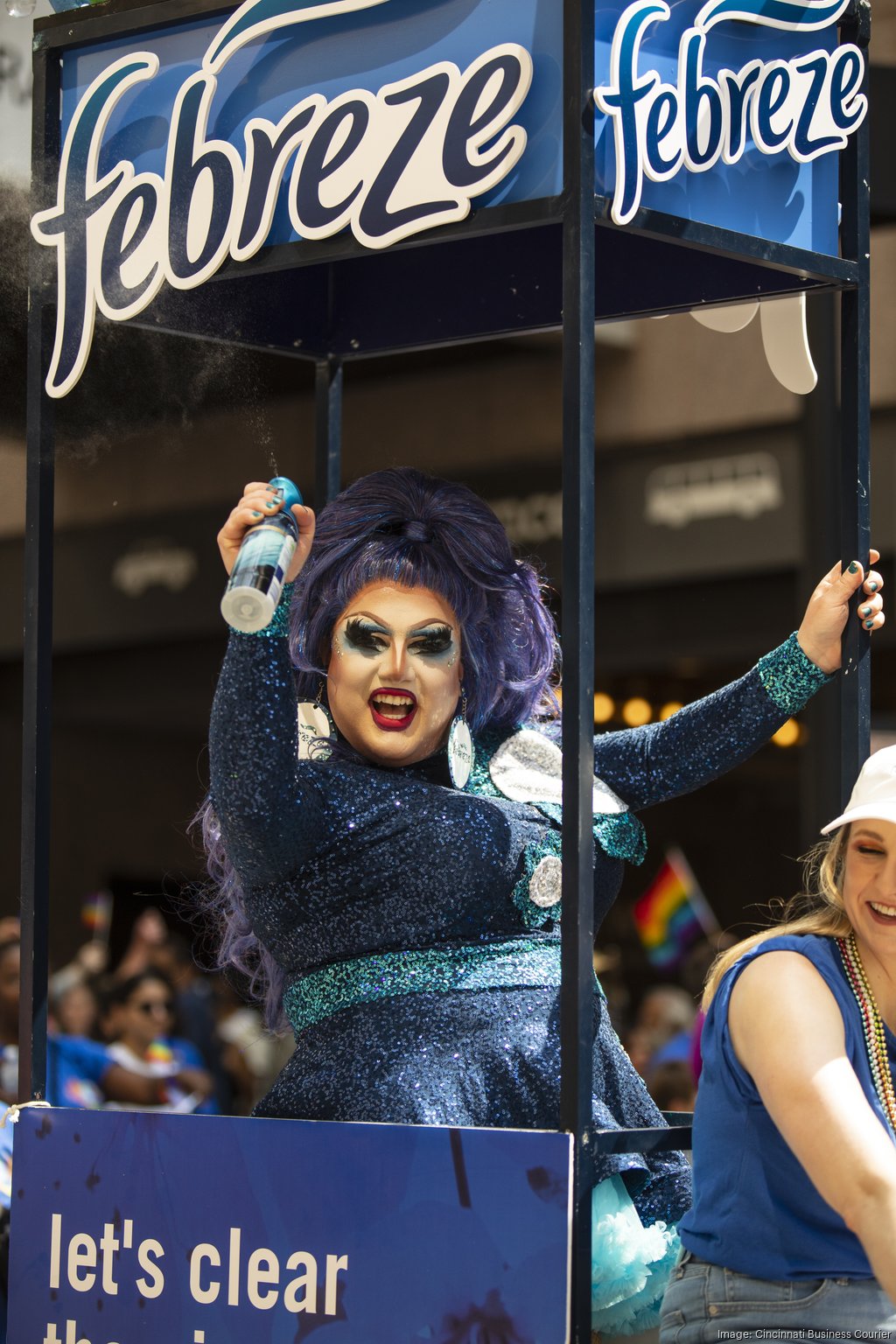
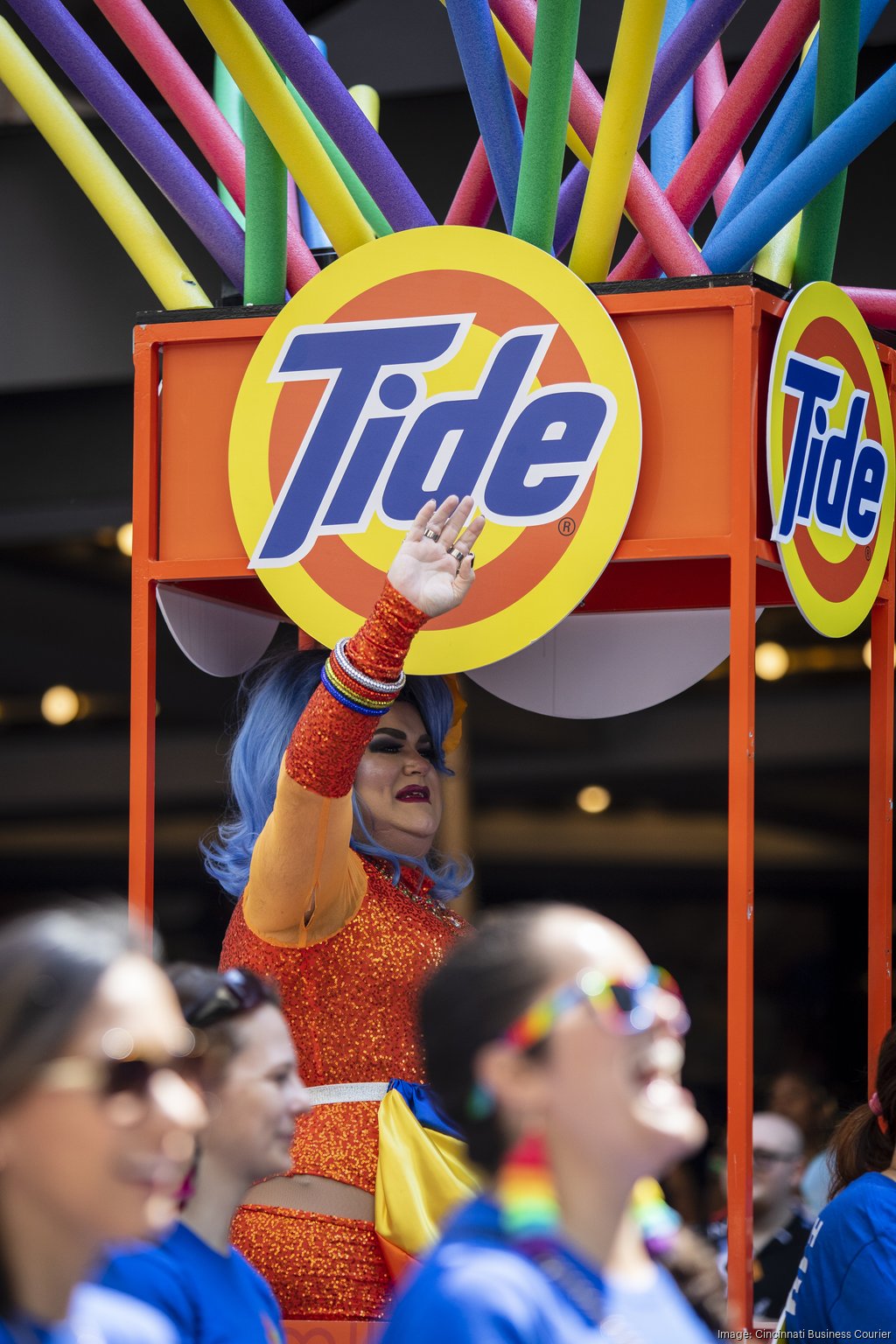
But most startling were the “brand bicycles.” Perhaps a dozen bikes pulled individual chariots which held a drag queen with a brand such as Febreze or Tide advertised above his head.

Read that last sentence again. On the streets of one of the most conservative cities, one of the most conservative corporations—a blue-chip of blue-chip company—was using drag queens to promote their household goods. It’s not a matter of when we will fall; we’ve already fallen.

This of course reveals the lie that the Rainbow Crowd is somehow oppressed or persecuted. It has captured the media, government, academia, and corporate America. Any institution with power now bows the knee to the Rainbow god. 

I won’t pretend that this isn’t discouraging. Seeing innocent young children being exposed to such depravity should fill any heart with righteous anger. Yet I still have hope in God’s action in the world. To my knowledge there had not been a Catholic presence at the Parade in previous years, but this year a couple dozen Catholics were there begging God for His mercy and witnessing to His love. May this mustard seed one day grow into a magnificent tree that overcomes the Satanic Rainbow Movement and brings many souls to Christ.

Jumping the Gun on Sister Wilhelmina?

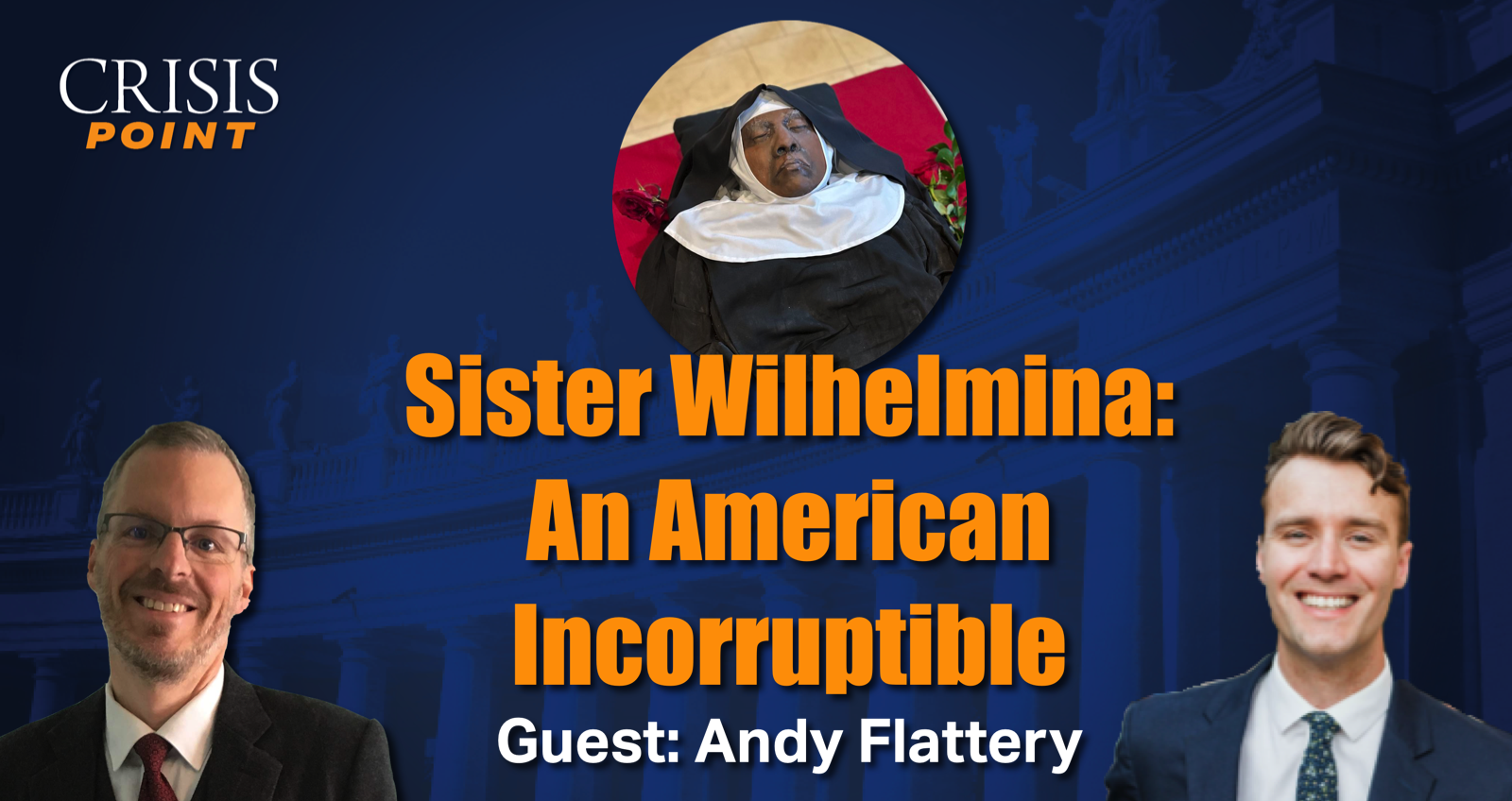
The biggest story among American Catholics this year is surely the incorrupt body of Sr. Wilhelmina Lancaster, foundress of the Benedictines of Mary Queen of Apostles. Thousands have flocked to venerate her body, and many, including me, are declaring it a miracle and Sister Wilhelmina a saint.

But some well-meaning Catholics are saying slow down: Shouldn’t Catholics wait for the Church’s official decision before believing Sister Wilhelmina’s body was kept miraculously incorrupt or that she is a saint? 

Well, yes and no.

Ultimately, it is the Church which has the final authority to make both determinations—if a miracle occurred and if she is a saint. Neither process has even begun. The local diocese of Kansas City-St. Joseph has issued a reasonable statement on the process, noting that “Bishop [James] Johnston is working to establish a thorough process for understanding the nature of the condition of Sister Wilhelmina’s remains.” It continues, “Bishop Johnston invites all the Faithful to continue praying during this time of investigation for God’s will in the lives of the Benedictines of Mary, Queen of Apostles; for all women religious; and all the baptized in our common vocation to holiness, with hope and trust in the Lord.”

Bishop Johnston is entirely correct to not accept at face value the claims of the miraculous and to note a process must be followed to determine the nature of what happened to Sr. Wilhelmina’s body. Miracles are alleged all the time, and Catholics should not be so incredulous to believe every claim as legitimate. A bishop has a duty to protect his flock from charlatans and scammers, and so he absolutely should be cautious before proclaiming anything publicly.

Further, the Benedictine sisters also issued a balanced statement in which they express their support and respect for following the proper process. They state, “While we can attest to Sister’s personal sanctity, we know that incorruptibility is not among the official signs taken by the Church as a miracle for sainthood, and that all things must be subjected to further scrutiny, especially by the competent authorities in the medical field. The life itself and favors received must be established as proof of holiness.” Their acceptance of following the proper process is entirely appropriate and demonstrates their great faith.

However, respecting the need for a formal process does not mean that the faithful cannot believe, right now, that a miracle occurred, or that Sr. Wilhelmina is a saint. We don’t have to wait for the official process to be completed before personally accepting divine action in this regard.

In fact, this is how these things typically have worked in the past. When a miraculous event occurs, it is the faithful who accept and proclaim divine intervention, creating a devotion that spreads organically. In response, Church officials then investigate. 

Consider Lourdes. Catholics didn’t wait for the official Church declaration before believing that the Blessed Virgin Mary had appeared to a young peasant girl or that a miraculous spring had arisen. It was only because of this widespread acceptance that Church officials decided to look into it.

The same is true historically in the case of canonizations. Most saints first had strong followings among the faithful before the process for sainthood even began. Again, throughout history it has been the strong following that instigates the process, not the other way around. It’s a “bottom-up” process, not a “top-down” one.

(An aside: today is the feast of Pope Paul VI, a perfect example of the modern tendency toward a “top-down” process. There was no significant devotion to this pope among the faithful after his death and his canonization was much more the Vatican imposing him on the faithful rather than the faithful desiring his canonization.)

But note that there are limits to the faithful’s acceptance of a miracle or the sanctity of a person before the Church makes a declaration. There must be acknowledgement that the Church has the final word on these matters, not the faithful. If the process were to discover some reason to doubt the miracle or a person’s sanctity, then the faithful must recognize the Church’s authority to reject the claims. 

Further, until the Church makes a proclamation these devotions remain private devotions. In other words, it would be inappropriate for liturgical celebrations to occur in honor of the miraculous event or for the person in question. There can be no Mass of “St.” Wilhelmina until the Church makes such a declaration. 

Catholics are wonderfully balanced when it comes to the miraculous: we are neither credulous, believing every claim of divine intervention, nor cynical, rejecting every claim. We are free to personally believe that God has intervened in the case of Sr. Wilhelmina’s incorrupt body, and also believe she led a saintly life, all while waiting for (and praying for!) the Church’s official declaration.

The Dodgers’ Flip-Flip-Flop

The Los Angeles Dodgers are one of the best-run organizations in baseball. In a highly-competitive league, where a team can win a World Series one year and be at the bottom of their division just a couple years later (I’m looking at you, Washington Nationals), the Dodgers have been at the top of their division for more than a decade. 

Yet recently this same organization demonstrated exactly how to give themselves a PR nightmare while also revealing the power of the Alphabet Mafia.

June is approaching, so of course most large corporations, which includes sports teams, need to determine how they will pay their protection money to the Alphabet Mafia. Corporate execs know that they must at least give lip service to the LGBTQ+ crowd else they face its wrath. Most baseball teams now host Pride Nights in which they celebrate sin to keep out of trouble on social media. 

The Dodgers wanted to use Pride Night to also “honor” various LGBTQ+ groups, and one of the groups they picked out was the Sisters of Perpetual Indulgence. The name alone should instruct the ignorant that this is a vile anti-Catholic organization. But the SPI are far worse than a normal person could even imagine. I can’t even describe their activities, but suffice it to say that they originate in the pits of Hell. 

When the Dodgers’ decision was announced, many Catholics protested, including Florida Senator Marco Rubio. To their credit, the Dodgers rescinded their invitation to the blasphemous “Sisters,” and Catholics could at least have one small victory in the battle against the Alphabet Mafia.

Not so fast.

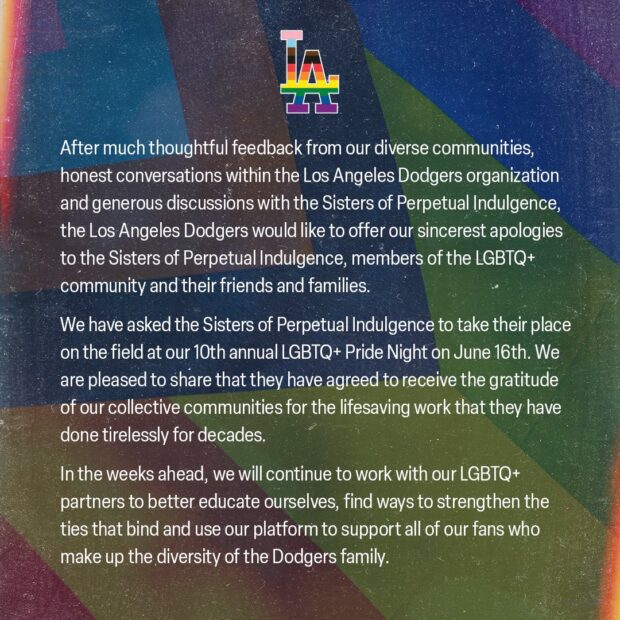
Yesterday, the Dodgers flip-flopped from their original flip-flop. They re-invited the anti-Catholic “Sisters,” stating, “[we] offer our sincerest apologies to the Sisters of Perpetual Indulgence, members of the LGBTQ+ community and their friends and families”. Read the full statement, it reads like a hostage letter:

After the Bud Light debacle, some might wonder why the Dodgers would want to alienate those who follow the world’s largest religion. After all, that’s bad business. However, there are a couple reasons this is different than the Bud Light situation. First, most people will never know how evil the Sisters of Perpetual Indulgence are. They will accept at face value the description of them as doing “lifesaving work” and will assume they are just an oddly-named charity, not an organization founded on blasphemy and degenerate behavior. That’s different from putting a guy in makeup in your face and making you say he’s a girl.

But the economics of baseball also come into play here. Unlike football or even basketball, baseball is very much a regional support. The vast majority of a team’s revenue comes from the local economy, and a large chunk of that revenue comes from luxury boxes at the stadium, which are usually bought by local corporations. These boxes give companies an opportunity to impress potential clients and reward employees. 

So in a city like Cincinnati, the luxury boxes will be owned by local companies such as Proctor & Gamble and Kroger. But what type of companies dominate Los Angeles? You can bet that Hollywood and other woke sectors are big customers of the Dodgers, and they likely put major pressure on the team to rescind their rescinded invitation.

This is why “Go Woke, Go Broke” isn’t always the case. With Bud Light, you had a company spitting directly in the face of its core customer base. Further, it was easy to boycott, as there are many alternatives to Bud Light available. But it’s not like most people in America were going to attend a Dodgers game this year anyway, and even if a few Catholics in LA decide to boycott the team, the real money is coming from those who support their decision.

Ultimately, the problem is deeper than boycotts alone can solve. The reason the Dodgers can honor an anti-Catholic organization is due to the weakness of the Church in America. The Church has lost her moral standing in the eyes of most people, and so a group that mocks our faith isn’t seen as extreme anymore. While we should fight against these attacks, we won’t truly change the culture until the Church once again boldly stands for traditional morality without compromise.

A special note from the editor of Crisis Magazine

Last week I wrote to ask for your gift to Crisis Magazine. This is one of only two annual fundraising appeals we make in any given year, and this spring we need to raise $75,000. 

Sad to say, we’ve received only a fraction of that.

Now, it’s possible my first appeal escaped your notice. I understand about being busy.

But I also know this about you: You’re one of us.

You read our articles and nod your head at the common sense you find there. You’re encouraged to realize that you’re not alone, that you’re not the only one who laments the widespread complacency in the Church and the corruption in the government. You know that leaders of both Church and State too often gaslight us to think everything is fine, when you know—and we know—it’s not. So you find yourself stirred up, ready to take bold action in your corner of the world. You’re moved to pray more, learn more, do more.

You believe in our powerful mission to speak light into a darkening age.

In short, you’re exactly the person we at Crisis need right now. We need you to be not only a reader but a partner. Otherwise, we can’t get this done. 

We’re not just any publication; we’re a lone voice crying out in the wilderness on matters of Church and State. Without your help, we could be gone, and the hard and hopeful truths we tell will be swallowed up in the sea of falsehood. 

Please make your gift today. Don’t wait for someone else. Don’t take it for granted that we’ll be here without you.

We need a lot of you to dig deep, to do what you can. A big gift would be so impactful – if you could do $12,500 to sponsor Crisis for about a month, that would be tremendous. A gift of $3,000 would cover us for a week.

Could you keep us online for one day, with a gift of $500?  

Or better yet, would you become a monthly donor by choosing that option on our secure donation form here.

Whatever you can give, please give today. Think about the gift that Crisis is to you, the value you receive from the writing that you find nowhere else but Crisis. As best as you can, please match that.

Crisis is a mission, and our content doesn’t cost readers anything to access. But it is worth so much. 

Please be more than a reader. We need you to be a partner today with your gift. 

Together we can restore our wounded Church and culture through our prayers and this work.

Thanks and God bless,

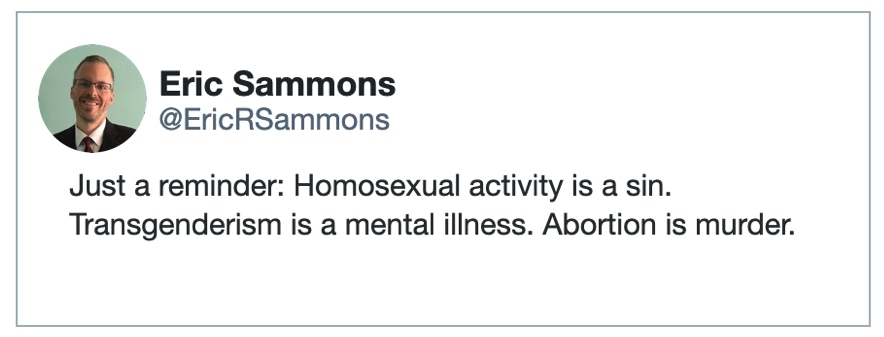
Eric Sammons
Editor-in-Chief

You can donate online
HERE

You can donate cryptocurrencies
HERE

You can send a check to:
Crisis Magazine
PO Box 5284
Manchester, NH 03108
You can donate by phone at:
800-888-9344

Naked and Unafraid

Today, publications like ours face a new and very serious crisis: Censorship.

And it’s not just the blocking of contrary ideas from social media platforms, the literal drowning out of alternate voices on college campuses, nor the longstanding biases of major media.

Those are bad enough (and they are plenty bad).

But what worries me most is the self-censorship that results from the hubris, the lies, the insults, and even physical attacks of today’s cancel culture.

It used to be that people would self-censor out of simple prudence, to avoid conflict, maintain a job, or as an act of Christian charity.

Now people are afraid to say what they think or write what they believe because of the backlash they risk facing. 

Do you support marriage, true marriage? You’re ignorant and a hater. 

Do you believe a person’s sex is “assigned at birth” and not changeable at will? You’re cruel and evil. 

Do you believe abortion should be outlawed? You’re a misogynist who wants women to be slaves.

Such name-calling is foolish, but it is genuinely intimidating to normal people. Human beings are social, and we need community. People will do almost anything to avoid being an outcast, even if it’s just psychological and not physical isolation. 

That’s what’s so unfortunate—the self-imposed censorship of the past few decades has largely silenced Christian conservatives and led to the acceleration of our decline as a republic. 

And let’s face it, that’s precisely the result the revolutionaries transforming our world desired.

But you know who isn’t intimidated? 

Who doesn’t shrink from insults and attacks?

Who tells it like it is—“naked and unafraid”—no matter the consequences?

Crisis Magazine. 

We’re going to tell the truth as we see it no matter what. We don’t care who disagrees with us or mocks us or even tries to take us down. To us it’s a rugby match out there, and the dirtier and bloodier our uniforms get the better.

What other publication—Catholic or otherwise—would publish an article on why divorced dads should avoid dating and remarriage in order to better love and lead their children? 

Or an article challenging common practices from tattoos to surrogacy to gender surgeries headlined “Theology of the Body vs. Body Mutilations”? 

Or an editorial that declares without apology, “The blunt reality is that the papacy of Francis, by any Catholic measure, has been a disaster”?

As you can see, we’re not making friends with people who want to fit in. That’s OK; we’re not trying to just go along and get along. We’re trying to wake people up. 

We’re informing, inspiring, and emboldening our readers to speak the truth in an era of lies!

If we’re having that effect on you, will you help us to continue doing it for others?

This is the time of year we come to readers like you to ask for your spiritual and financial assistance to continue this mission. It’s a team effort; we can’t do it without you. 

Right now, we need to raise $75,000 from our grassroots army of supporters to complete our website upgrade and pay all our bills. We want to maintain our online platform, produce our podcast, and continue to hire the best writers out there to make our content as bold and beautiful as ever.

People come to us for answers and we want to keep providing them!

Will you please help support the mission of Crisis Magazine with a tax-deductible gift today? Could you sponsor the magazine for a month with a gift of $10,000? Or for one week with a gift of $2,500? Could you keep us going for a day with a gift of $500?

If not, could you make a gift of $50, $75, or $100?  We need your gift, whatever it is.

*    *    *

The most important way you can give is to become a monthly donor by choosing that option on the donation form. 

For a site that provides content each and every day, monthly donations provide us the security and stability we need to operate throughout the year.

*    *    *

Please support us so we can push back hard against the prevailing censorship with the gleaming swift sword of truth. 

Don’t be afraid, friends. We’re not.

Thanks and God bless,


Eric Sammons
Editor-in-Chief

P.S. Please take this opportunity—it only comes twice a year—to make your most generous gift to support the bold voice of Crisis Magazine. It will bear tremendous fruit!

You can donate online
HERE

You can donate cryptocurrencies
HERE

You can send a check to:
Crisis Magazine
PO Box 5284
Manchester, NH 03108

You can donate by phone at:
800-888-9344

Archbishop Paglia’s Anti-Life, Anti-Catholic Crusade

The president of the Pontifical Academy for Life, Archbishop Vincenzo Paglia, has exposed his contempt for life yet again. This time, he’s publicly endorsing assisted suicide while making a mangle of the Church’s moral authority.

First, Paglia channels his inner Mario Cuomo by stating, “Personally, I would not practice suicide assistance, but I understand that legal mediation may be the greatest common good concretely possible under the conditions we find ourselves in.” If the Archbishop were American, I would swear he sounds like he’s running for the Democratic presidential nomination.

But Paglia’s endorsement of assisted suicide isn’t the real problem; his anti-life views are just a symptom of his anti-Catholic morality. He dismisses the Church’s teaching authority by stating that the Church is not a “dispenser of truth pills.” Then he states,

The contribution of Christians is made within the different cultures, neither above — as if they possessed an a priori given truth — nor below — as if believers were the bearers of a respectable opinion, but disengaged from history.

“As if they possessed an a priori given truth?”—that’s exactly what the Church possesses! While Paglia is trying to sound humble, he’s actually expressing supreme arrogance. For he is assuming that the Church comes up with her own morality, as if it is man-made. Yet all that the Church possesses—including her moral teaching—has been given to her as a gift from above. Its source is God Himself, Who is Himself “a priori.”

In Paglia’s view of how the Church’s teachings comes about, she must interact with society to adapt her morality according to the latest findings of (pseudo-)science and the latest cultural fads. It is not given to her by God, through both reason (natural law) and revelation. Thus, even the command “thou shalt not kill” is up for debate and discussion and “development.” Such a view upends all of Church teaching; it is no longer founded on a rock, but on sand.

Paglia goes on to state, “Between believers and non-believers there is a relationship of mutual learning.” When it comes to settled moral teachings, this is simply false. Catholics have nothing to learn from non-Catholics, for to suggest this is to suggest that Catholics should no longer learn from God Himself but instead from fallen man. Again, it is arrogance masquerading as humility.

Of course, the great scandal here is that the anti-life, anti-Catholic Paglia is the president of the Pontifical Academy for Life. Every day he remains in office diminishes the moral authority of that academy as well as the moral authority of the pope who oversees it.  

The Dynamics of Restricting Liturgical Rites

The essential argument of Pope Francis and others who wish to restrict or even ban the celebration of the traditional Latin Mass boils down to “If a liturgical rite is causing people to embrace bad theology, then it should be banned.” Since some attendees of the TLM are embracing a bad ecclesiology (i.e., “schismatic tendencies”), then the TLM itself should be removed from the equation, they believe.

On the surface, this is a plausible argument. After all, one of the fundamental maxims of Catholicism is lex orandi, lex credendi, which means the law of prayer is the law of belief. In other words, how we pray and worship greatly impacts what we believe. So, if a liturgy is influencing bad belief, perhaps it needs to be curtailed by Church authorities.

However, let’s examine this argument a little more specifically in today’s situation, and dig into the track record of the traditional Latin Mass (TLM), as well as the Novus Ordo Mass (NO). After all, if a liturgical rite can be blamed for the bad theology of some of its attendees, then all rites should be examined to ensure we remove any and all offending liturgies.

The TLM as celebrated today is the result of an organic development that stretches over a millennium in the past. How the TLM is celebrated in 2023 isn’t much different than how the Roman Rite was celebrated in 1923, 1223, or 623. Millions of Catholics have been formed in their beliefs by this Mass during this long time, including saints such as St. Gregory the Great, St. Thomas Aquinas, St. Teresa of Avila, and St. Maximian Kolbe. 

Of course, this liturgy also formed many of the great heretics of the past, such as John Wycliffe, Martin Luther, and John Calvin. In other words, the traditional Roman Rite does not have a 100% batting average, producing only orthodox believers. Due to the fallen nature of man, there will always be those who attend a perfectly orthodox liturgy and still end up professing heresy. But on the whole, it’s hard not to be impressed with what the traditional Roman Rite has produced; it was the bedrock of medieval Christendom, the most glorious and authentically Catholic era of all time.

The Novus Ordo, it goes without saying, has a much shorter history, having been instituted in 1970. Now for those who argue that the NO is simply an organic reform of the TLM, I would just note that this is not what those who wish to restrict the TLM are saying. They are treating the NO as fundamentally different from the TLM; after all, they are claiming that the TLM is harmful to the faithful (why else would you restrict it?) whereas the NO is not. They are implicitly (and sometimes explicitly) arguing that the Novus Ordo didn’t reform the traditional Latin Mass, it replaced it.

But in the short history of the NO, what do we see? In the West at least, we see mass apostasy: millions of Catholics, who grew up in the NO, have left the Church. Just as troubling, a majority of those who still regularly attend the NO are functional heretics. As just one example, polls show that almost 70% of Catholics in America do not believe in the Real Presence. Other indicators, such as the widespread Catholic acceptance of artificial contraception, confirm this tragic reality. 

Now, just as the traditional Roman Rite produced some heretics such as Martin Luther in the midst of centuries of widespread orthodoxy, likewise the NO has produced saints in the midst of 50 years of widespread heresy. Of course, since the new Mass is so, well, new, there are only a few canonized saints of this era, but suffice it to say that many holy people have attended the NO for either their whole lives or at least for a large section of it.

That being said, if we are going to establish the standard that “a liturgical rite that causes people to embrace bad theology should be banned,” it’s hard not to see which of the two liturgies should be eyed for retirement. The contrasting track records of the TLM and the NO, when put side-by-side, are clear.

If we are going to establish the standard that “a liturgical rite that causes people to embrace bad theology should be banned,” it’s hard not to see which of the two liturgies should be eyed for retirement. Tweet This

To be clear, I’m not arguing here for the restriction or elimination of the Novus Ordo. I’m arguing against the logic promoted by the pope and others to curtail the TLM. It places the blame for supposed bad actors away from the individuals and toward a practice that has over 1,000 years of proven value. Should 16th century popes have banned the traditional Roman Rite because it was what Luther, Calvin, and Zwingli grew up in? Of course not, such a suggestion is absurd. But it’s actually less absurd than the idea that today’s TLM should be shut down because of issues with a few YouTubers and mean tweeters. 

When the Church has a problem with individuals in her midst that are sowing dissent, she has a mechanism to deal with that: confront the individuals and call them to retract their problematic views or be excommunicated. The fact that Church leaders today don’t do that but instead direct their ire on a venerable and proven rite of the Church suggests that the issue is not what they claim it to be.

10 Years of Confusion, Political Ideology, and Scandal

Today is the 10th anniversary of the election of Jorge Bergoglio to the papacy. It’s customary on anniversaries to look back and reflect on the years spent together, but my mom also told me if I can’t say something nice, I shouldn’t say anything at all, so I’m not sure what to do today. I guess I’ll ignore mom.

The blunt reality is that the papacy of Francis, by any Catholic measure, has been a disaster. It’s not that he hasn’t at times done some good acts or spoken some good words; it’s that the overall thrust of his pontificate has been one of confusion, political ideology, and scandal. 

In the first year of his papacy Francis uttered the infamous words, “Who am I to judge?” and ever since then he has done far more to confuse the faithful than confirm them. While popesplainers have created a cottage industry trying to explain why the plain meaning of Francis’s words are not his actual meaning, most reasonable people have understood that he means what he says, even when what he says makes little sense. Further, his individual statements are not spoken in a vacuum: while one might be able interpret each of his more troublesome statements in a fully Catholic sense if we squint enough, when taken as a whole over ten years, it’s clear that Francis wishes to undermine many of the practices—and even teachings—Catholics have held dear for centuries.

There’s one thing, however, about which the pope is not confused: his political agenda. Pope Francis has turned the Vatican essentially into a political NGO. While every pope rightly should comment on politics, the office of the papacy isn’t to advocate for the latest United Nations initiative or World Economic Forum plan. It’s to proclaim the saving Gospel of Jesus Christ as found in the Catholic Church. Yet Francis seems to use his moral authority not to urge people to convert to Catholicism (in fact, he appears to abhor conversions), but to push the latest globalist political agenda, such as combating climate change or immigration reform. By associating himself—and thus the Catholic Church—with these worldly goals, he diminishes the ability of the Church to rise above political differences to point to a spiritual path to salvation.

And while the media—particularly Catholic media—want to ignore it, this papacy has been rife with scandal. Beyond the scandal of Francis’s own confusing words, there are the multitude of scandals involving abusive prelates and priests who have received preferential treatment if they are ideologically aligned with Francis. The public revelation of former Cardinal Theodore McCarrick as a monster seriously undermined Francis’s stated goal to clean up the Church. Here was a man who was known as a predator by many high-ranking Catholics—including the pope himself—yet he was placed in the “inner circle” by Francis early in his pontificate. 

Countless other scandals have littered the past 10 years, but the most recent one regarding Fr. Marko Rupnik, S.J. might be the most troubling. The accusations against Rupnik are shocking, and the fact that he seems to still enjoy favor at the Vatican in spite of those accusations reveal a deeply dysfunctional Curia. Combine the Vatican’s inaction when it comes to Rupnik with its jihad against traditional Catholics and you have a recipe for a Rome in shambles.  

Confusion, political ideology, and scandal have been our continual companions the past 10 years, and there’s little reason to believe that will change while this pope still reigns. Some Catholics attempt to explain these problems away (or even claim they are good things!); other Catholics try their best to ignore them. Sadly, many Catholics have broken communion with the Catholic Church, for atheism/agnosticism, Orthodoxy, or sedevacantism. While each person is responsible for his own decisions, Pope Francis will also have to answer for these defections on his day of particular judgement. 

For my part, I still see hope in the midst of these problems. If nothing else, the misadventures of Pope Francis have allowed Catholics to more deeply understand the papacy, both its authority and its limitations. While many orthodox Catholics might have lived in a state of blissful hyperpapalism under John Paul II and Benedict XVI, Francis has reminded us that the true head of the Church is Jesus Christ, and his Vicar is not guaranteed to be faithful to Him in everything he does. 

Further, times of trial, such as we live in now, are the best times for growing in holiness. It’s widely accepted that the best way to physical fitness is to put stress on your body in various ways, whether through weight-lifting, running, fasting, or other strenuous activities. Likewise, spiritual fitness only comes through stress as well: being pushed to choose the Lord in spite of temptations to leave him. In an era of a troublesome pontificate, we must decide to follow Christ and cling to him in spite of the confusion, political ideology, and scandal that currently emanates from Rome. 

The FBI Tags TLM Communities as Homes for “Violent Extremists”

It would be understandable if someone who attends a traditional Latin Mass (TLM) parish would feel a bit paranoid these days. After all, there’s rumors that Pope Francis is planning to release a “Traditionis Custodes 2.0” soon, in which the TLM will be further restricted and celebrating any of the other Sacraments in the traditional form will be prohibited. That alone could make the average TLM-goer feel as if he has a target on his back.

But that’s just the beginning. This week it was revealed that the FBI is looking into “radical traditional Catholic” parishes as possible enclaves of white supremacy and “racially and ethnically motivated violent extremists.”  Former FBI Special Agent Kyle Seraphin released a secret report from the FBI Richmond (VA) Division that detailed how the FBI views traditional Catholics.

As someone who regularly attends the TLM, I found this report a fascinating look into the fantasy world in which the FBI apparently operates. Comparing my own parish to what is written in this document is like comparing apples to rotten oranges. The “Rad Trad” community is often accused of participating in crazy conspiracy theories, but it has nothing on the FBI’s foray into tin-foil-hat-level conspiracies as seen in this report.

The Executive Summary of the report states that “radical-traditionalist Catholics (RTC) are typically characterized by the rejection of the Second Vatican Council (Vatican II) as a valid church council; disdain for most of the popes elected since Vatican II, particularly Pope Francis and Pope John Paul II; and frequent anti-Semitic, anti-immigrant, anti-LGBTQ, and white supremacist ideology.” I’m a little surprised the Feds didn’t say RTCs like to torture puppies and steal candy from babies.

Of course these accusations look like the talking points from the Catholic Left that combine a little bit of truth with a whole lot of lies. It’s true that RTCs are at least critical of Vatican II (almost all I know do not reject it as a “valid church council”), and they are also critical of Pope Francis and even Pope John Paul II (but “disdain” is a loaded word). But then the stereotypical laundry list of “antis” is simply a lazy way of saying, “We don’t like them so we’ll smear them with the latest woke insults.”

The concern of the FBI is that “racially or ethnically motivated violent extremists (RMVEs)” will find an attractive home among RTCs because the two groups supposedly have similar views and ideologies. As the report states, “Catalyzing events in which RMVEs and RTC adherents might have common cause include legislation or judicial decisions in areas such as abortion rights, immigration, affirmative action, and LGBTQ protections.” Did you hear that, Catholics? If you (rightly) oppose the Left’s political views, you might just be a violent extremist!

Also interesting is that the FBI actually mentions a few groups. It names Church Militant in report itself, stating, “investigations have noted a growing overlap between the far-right white nationalist movement and RTCs. Illustrative of this has been the increasing collaboration of the far-right Catholic media outlet Church Militant with the America First/“groyper” movement.” Even more revealing is an appendix to the report which lists nine organizations that the Southern Poverty Law Center defined as “hate groups,” including Catholic Family News and The Remnant.

My initial reaction when I saw the SPLC list was disappointment that our sister publication OnePeterFive wasn’t included! At this point, being labeled a “hate group” by the vile SPLC should be considered a badge of honor. While I’m not overly familiar with every group on this list, I feel confident that none of them are actually hate groups.

Another sign of the sad state of this report is that multiple footnotes used to back its claims are from the far-left websites like Salon and The Atlantic. Not exactly trying to be objective, are we, Mr. Fed?

While it might be easy to laugh at this report it does reveal a sinister attitude among many of those in positions of power. At a time when Antifa and BLM terrorists are roaming our streets, the FBI thinks the 15-passenger van with the Pray the Rosary and FSSP bumper stickers is the real threat to our democracy. 

My advice to fellow TLM-goers is two-fold.

First, all orthodox Catholics, whether we consider ourselves traditional or not, should see this as a move against all of us. The so-called “Rad Trads” are just the first line of attack for the elites who wish to silence and even destroy Catholicism. Don’t fall into the error of thinking that the Feds won’t eventually turn their sights on non-traditional Catholics just because you went along when they wanted to silence traditionalists.

Second, while it’s true that our elites hate us and want to see us disappear, don’t allow that disturbing reality to blossom into paranoia and break one’s peace. If some FBI agent tries to infiltrate a TLM community, he’s likely to find generous, salt-of-the earth people (of various races and ethnicities, by the way). Perhaps if he stays long enough, he might end up realizing the beauty of the Catholic Faith and might himself eventually be tagged a “radical-traditionalist Catholic.”

[Update 2/10/23: Since this was published, the FBI has announced that they will be retracting this report as it “does not meet the exacting standards of the FBI.” In other words, they got caught.]

The Great Pat Buchanan Signs Off

Pat Buchanan—political pundit and three-time presidential candidate—announced he is retiring from writing. Buchanan hasn’t been as much in the spotlight in recent years, but those of a certain age can remember when he was almost as big of a political player as Donald Trump. And in fact, he was Trump before Trump (and a lot better, too!)

Buchanan first hit the political scene working in the Nixon White House in the early 1970’s as President Nixon’s assistant and speech writer. While this might seem a low-level job, Buchanan had a great impact on Nixon’s presidency and the Republican Party in general. It was Buchanan, for example, who came up with the phrase “silent majority” that helped bring many Democrats to the Republican fold.

After Nixon left office Buchanan launched a highly successful career as a political pundit, hosting or contributing to various radio and TV shows. There was a time when any political show worth its salt would have to include Buchanan either in their lineup or as a regular guest. He spent two years in the mid-80’s working for the Reagan White House, but in the early 1990’s he decided to run for office himself…and boy, did he make a grand entrance.

In response to President Bush (the elder) reneging on his promise of “no new taxes,” Buchanan launched his own campaign for the Republican presidential nomination in 1992. At first this seemed a quixotic campaign: what Republican would vote for a TV commentator against an incumbent President? But Buchanan’s campaign gained serious momentum, and he had a strong showing in the New Hampshire primaries, forcing Bush to move to the right to compensate.

Buchanan ran again in 1996, and this time he won the New Hampshire primaries against the favorite, the incredibly bland and boring Bob Dole. At one point it looked like Buchanan had a serious chance to grab the nomination, but Dole’s establishment political machine eventually prevailed, steamrolling Buchanan on Super Tuesday.

In 2000 Buchanan ran once more, this time securing the nomination of the Reform Party (Ross Perot’s party). He garnered few votes in the national election, and his days of running for office ended as he returned to full-time punditry.

What made this former speech writer so popular in the 1990’s? In a sense, he was the “anti-Bush.” George H.W. Bush was the perfect representation of the “country club Republicans,” the rich, white men who wanted to control world affairs from the White House and cared little for the “little guy.”

However, with an influx of working-class voters into the party during the Reagan years, many Republicans felt distant from that brand of conservatism. In addition, as the Democratic Party moved more and more to the radical Left (a movement that still hasn’t slowed down), its working-class voters also felt alienated and saw Buchanan as a possible alternative.

If this sounds familiar, it should, because it’s essentially the model used even more successfully by Donald Trump in 2016. Trump, whether intentionally or unintentionally, often imitated Buchanan. Trump’s hesitation about foreign interventionism reflected Buchanan’s own foreign policy views. His support for tariffs and emphasis on helping working-class people also emulated Buchanan’s campaigns. 

Buchanan, of course, is far better than Trump, both as a person and a candidate. He is extremely intelligent, understanding complex issues and with an ability to explain them to non-experts. Further, he is a faithful Catholic who strongly believes—and practices—what the Church teaches. A Catholic could be forgiven for dreaming what the country would be like if Buchanan and not Trump had been the one to achieve the presidency.

Personally, I rank Pat Buchanan up there with Ron Paul as my favorite modern politicians. Buchanan was fearless, saying the most controversial things (he wrote a whole book attacking Winston Churchill!) without worrying about how it might impact him in the polls. He was also willing to change his views after careful consideration. He began his career as a foreign policy hawk, parroting the neocon narrative about the need for American interventionism, but eventually he recognized the folly of those views and became one of the country’s leading advocates for peace and non-interventionism. 

In recent years, mostly due to Trump’s influence, the Republican Party is starting to catch up to Buchanan’s views, and it couldn’t come soon enough. Although Buchanan is retiring from public writing, it’s my hope that the next generation of conservatives look to Pat Buchanan (and not Trump) as a model for the future of the movement. 

The Devilishly Heretical Fr. James Martin

I’m currently under Twitter suspension again, this time for offending the sensibilities of Big Gay (I dared suggest that gay men were inordinately attracted to young men and even boys). While I’m banished to the social media nether regions (no pun intended), the chaplain of Big Gay, Fr. James Martin, is at it again.

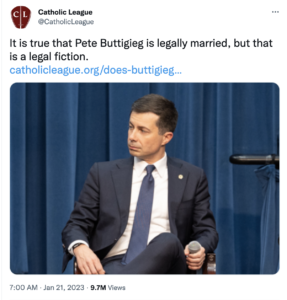
It started when the Catholic League tweeted, “It’s true that Pete Buttigieg is legally married, but that is a legal fiction.”

For those unaware, Pete Buttigieg is the current United States Secretary of Transportation. A former Catholic who is now Episcopalian, he “married” another man, Chasten Glezman, in a private ceremony at the (Episcopal) Cathedral of St. James in South Bend, Indiana in 2018. 

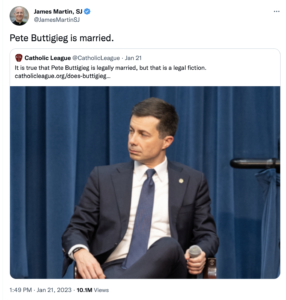
Fr. Martin, who opines incessantly on social media about All Things Gay, of course could not let that statement of plain Catholic (as well as natural law) teaching go unchallenged. He responded simply, “Pete Buttigieg is married.”

This is typical Martin fare. He makes a statement that he clearly wants to be interpreted in a heretical way but is written so that he has plausible deniability if by some miracle a Church hierarch should challenge it.

Remember that the Catholic League acknowledged that Buttigieg is “legally married,” but called it a legal fiction. So when Martin says that Buttigieg is “married,” without any qualifier, the most plain meaning (and the one Martin wants you to have) is that Buttigieg’s gay “marriage” is a true marriage, not just a legal one.

At the same time, Martin’s lack of a qualifier allows him some wiggle room were he to be challenged by a superior. He could just claim, “I was just talking about the legality of the marriage under U.S. law—I wasn’t saying it was the same as a heterosexual marriage!” 

In making such weaselly statements, Martin imitates that master liar, Satan. In the Garden of Eden, the devil urged Eve to eat the fruit of the tree in the middle of the garden. When Eve objected that God told her she would die if she did, the Old Snake responded, “You will not die” (Genesis 3:1-4). In a certain sense, the devil is telling the truth; after all, after Eve eats the fruit she doesn’t immediately drop dead. But of course Satan’s half-truth conceals his lie, for he knew that by eating the fruit Eve will die—she will break her communion with God and be under the reign of sin and death. 

So as we can see, Martin’s playbook is as old as mankind itself, tracing all the way back to our first parents’ Fall. His ambiguous, partially-true statement is far more effective than an outright lie; it allows those who want to be deceived to claim a Catholic covering for their deception, and it fools the naive into letting Martin off the hook.

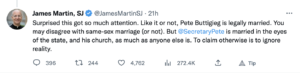
Later Martin feigned shock at the considerable backlash to his tweet: “Surprised this got so much attention. Like it or not, Pete Buttigieg is legally married. You may disagree with same-sex marriage (or not). But @SecretaryPete is married in the eyes of the state, and his church, as much as anyone else is. To claim otherwise is to ignore reality.”

But of course Martin was not surprised—he got the exact reaction he intended by the words he used. He wanted people to believe he was putting Buttigieg’s faux-marriage on par with a marriage between a man and a woman. Perhaps if this was the first time Martin had made such a two-faced statement we might give him the benefit of the doubt, but it’s clear from his history that he uses these statements to further push for his heretical desire to normalize homosexual relations.

When dealing with the devil (or his minions) Catholics need to oppose half-truths and ambiguities with clear, direct, and fully-true statements. In this situation, we need to state directly that Fr. James Martin is a heretic who should not be allowed to continue his public ministry as a priest. If we mitigate that truth in any way, trying to defend Martin or giving him the “benefit of the doubt,” we simply fall for the trap designed by the devil himself and practiced to perfection by Martin.

Moving Epiphany: Reducing Men to Cogs in a Machine

Today is January 6th, and although in the media this day is quickly becoming the Feast of the Great Insurrection, for Catholics January 6th has always been the magnificent Feast of the Epiphany. Yet in recent years in the United States January 6th is only the Feast of the Epiphany when it’s lucky enough to fall on a Sunday.

Even though Epiphany is one of the most ancient feasts on the Christian calendar (being celebrated at least as far back as the 2nd century—even older than Christmas!), our bishops decided that it wasn’t important enough to deserve us setting aside time during our busy weeks to celebrate it. Instead, for our convenience, they set aside Epiphany itself on this day and move it to a nearby Sunday when we can (hopefully) squeeze it into our schedules. 

I understand the reasoning for this decision, even if I think it unfortunate. Our bishops recognize that many Catholics do not revolve their lives around the Church calendar and so if Epiphany were celebrated during the week, many, if not most, Catholics would simply let the day go by and not even realize it was a feast day. They would not attend Mass and the day would be completely forgotten. But if Epiphany is moved to Sunday, the thinking goes, then at least those Catholics who have Sunday Mass as part of their schedules will celebrate this important feast. 

The logic is reasonable…and completely wrong-headed.

As John Grondelski notes in a Crisis article today, the Church gives us a calendar that is not in conjunction with the secular calendar, and we would do well to conform our lives more to that liturgical calendar. Having feast days that stick out, so to speak, reminds us of the events that led to our salvation. These special days prevent us from falling into a utilitarian routine which is only based on the workweek and the demands of this world. 

When important feasts like the Epiphany fall on a weekday, we are given an opportunity to escape from the mundane tasks of this world and enter into the infinite mysteries of our Faith. We allow the infinite to touch our very finite world.

In a way, the bishops trying to fit the liturgical calendar to the demands of the secular calendar remind me of the attempt during the French Revolution to change the calendar into 10-day weeks. It was touted as being in keeping with the “new man,” who revolved around work and his duties to the State. Of course it failed miserably, as man was not made for this world, but the next.

Likewise, when we prioritize the secular calendar over the liturgical calendar, we reduce man to cogs in a materialistic machine, who cannot escape the demands of the five-day work week, even to celebrate one of the most important feasts of the year. 

Moving Epiphany to the nearest Sunday, while it may have been done with the best of intentions, sends the wrong message to Catholics. It tells us that secular demands—work, school, etc.—are more important than the demands of our Faith. It tells us that we should not re-order our lives to the Faith, but instead just fit it in where convenient. Sadly, we see that too many Catholics today have taken this cue from the bishops and do exactly that.

Moving Epiphany to the nearest Sunday, while it may have been done with the best of intentions, sends the wrong message to Catholics. It tells us that secular demands—work, school, etc.—are more important than the demands of our Faith.Tweet This

If we want to see a revitalization of the Catholic Faith in our time, we need to put the Catholic Faith first in our lives. One small way to do that would be to move Epiphany back to January 6th, where it belongs.

The Rebranding of the Latin Mass Movement

Does the Latin Mass movement need a “rebranding?”

If you ask the good folks responsible for the Mass of the Ages documentary series, the answer is a resounding “yes.” They love the traditional Latin Mass and lament the fact that less than 2% of Catholics attend that liturgy. They argue that one of the biggest reasons for that small number is the perception that surrounds regular attendees of the Latin Mass: that they are “mean” and “unwelcoming,” and overall have an insular attitude.

But if you ask many long-time Latin Mass attendees if the movement needs a rebranding, they will likely bristle at the suggestion. They defend the overall way Latin Mass goers comport themselves, and feel that an effort to rebrand is falling for stereotypes and even gaslighting from Church officials.

It’s a battle between the Latin Mass New Guard (most of the Mass of the Ages team consist of younger and relatively more recent attendees of the old rite) and the Old Guard. 

So, does the Latin Mass movement need a rebranding?

As a Latin Mass “Middle Guard”—I’ve attended the TLM for more than 11 years now, but I don’t date back to the pre-Summorum Pontificum days—I find myself caught in the middle of this debate. On the one hand, I recognize the negative perception many Catholics—and many Catholic leaders—have of Latin Mass attendees, but on the other hand, I also think much of this perception is set by those in power who fundamentally oppose the spread of the Latin Mass for reasons far deeper than “mean trads.”

First, I will admit that I’ve experienced negative influences within the “trad” world, particularly online. I’ve been labeled a “semi-trad” more times than I can count because I don’t always subscribe to the pure traditionalist line. I’ve seen faithful Novus Ordo-attending Catholics attacked by traditional Catholics for the slightest infraction of what certain traditionalists think is “true Catholicism.” So I won’t argue that there’s a problem there.

Yet I would also argue that there’s a problem everywhere, due to the Fall. I’ve seen nasty Catholics from every subgroup in the Church. Try to kneel and receive Communion on the tongue in a more liberal parish—then you’ll see mean and unwelcoming in spades. Or witness the nasty looks you get if you dare not hold hands during the Our Father (at least, in pre-Covid days). Or just see how nasty Catholics can be online talking about how nasty traditional Catholics are.

So while traditional Catholics should be more charitable and humble, so should all Catholics. I’m not convinced that it’s a problem specific to traditional Catholics.

Yet Pope Francis himself supports and endorses this negative perception of traditional Catholics every time he talks about them. In fact, he gave this perception as the reason he was restricting the Latin Mass in his motu proprio Traditionis Custodies. He also claimed that many bishops had complained to him about the attitude among traditionalists, which is why he felt he needed to curtail the TLM.

But to be blunt, this is gaslighting. First, Diane Montagna demonstrated that the bishops’ did not oppose the Latin Mass as Francis claimed. Second, it’s hard to believe that the pope would think contradicting his predecessor and causing massive headaches for bishops around the world would be the proper response to a few mean trad tweeters. 

So if, as most regular Latin Mass attendees believe, the Latin Mass is superior to the Novus Ordo, why do so few Catholics actually attend it? Is it because of a negative perception that needs rebranding?

While I won’t argue that a rebranding on some levels wouldn’t help, I don’t think that’s the fundamental issue at play. My own experience working for a diocese leads me to believe it’s deeper than that.

From 2011-2016 I worked directly for a bishop as a diocesan director of evangelization. During that time I attended the Latin Mass, and I wasn’t the only chancery employee who attended the TLM. Our bishop had invited the FSSP into the diocese to celebrate Mass at three locations across the diocese. He celebrated the confirmation of two of my daughters in the traditional form. In other words, he was obviously friendly to the Latin Mass, and he had positive perceptions of Latin Mass attendees.

That being said, he would have never allowed more Latin Masses in his diocese. Why? Again, not because he had a negative impression of the Latin Mass movement, but because he, like almost every bishop, perceived Catholicism through a modern, post-Vatican II lens. He accepted as foundational the belief that the Novus Ordo is the Mass of the Church, and that the Latin Mass, for all its beauty and grandeur, is simply a relic that a few Catholics still cling to but will eventually fade away. 

He didn’t think this out of animosity to anyone, but simply as the reality on the ground. Even if the Latin Masses grew in attendance (which they did), that would not dissuade him from his fundamental presuppositions.

No rebranding would likely change that bishop’s mind, nor the mind of most bishops and clerics. The issue is much deeper, and changing the minds of our Church leaders involve radically shifting their views about the purpose of the liturgy and even how Catholics live their faith. It’s not just convincing them that traditionalists are nice.

Again, I’m not opposed to the rebranding efforts of the Mass of the Ages team—anything to promote the Latin Mass to a larger audience is a good thing, in my mind. But it will take much more than a rebranding effort to get Church leaders to become more receptive to expanding the celebration of the Latin Mass.

Musk’s Twitter Still Silencing Catholics

The Elon Musk takeover of Twitter promised to usher in a new era of free speech on the social media behemoth.

Not so fast.

While Leftists have been throwing conniption fits about the very idea of letting people express opinions contrary to their own, conservatives have been rejoicing that perhaps now we can speak the truth without fear of banishment to the nether regions of the online world (like Parler!). And while it does seem like Musk is opening Twitter up (he recently restored Trump’s account), there are apparently still limits to what you can say on Twitter, as I recently found out.

Last March, I tweeted the following:

While I know these statements are controversial, they are all objectively true. At the very least, they are views held by millions of people today (including all faithful Catholics), and have been held by almost everyone for most of human history. Further, in no way do I call for harassment or violence against anyone.

Yet a few hours after that tweet I received a notice from Twitter stating that my account was locked for “hateful conduct.”

I was required to delete the tweet in order to restore my account, which I eventually did.

Yesterday I decided to see if Twitter has really changed since the Musk takeover. So I tweeted out the March notice from Twitter and restated the content of my original tweet.

Same result:

I realize a lot of the suspension process is likely automated, and it’s not like Musk has been in charge long enough to make systemic changes at the company, but it was still disappointing to see that controversial statements that counter the woke establishment are still not allowed on the world’s biggest social media platform.

There is an appeal process when your account is locked, but I didn’t bother back in March since I knew it would be pointless. This time, however, I decided to appeal to see if perhaps Musk’s influence has filtered down to that level.

Until then, I’ll remain locked out of Twitter, which honestly isn’t the worst thing during this penitential season of Advent.

UPDATE 12/1/22 2:20PM ET: My appeal failed:

Meet the new boss, same as the old boss.

Item added to cart.
0 items - $0.00